Why should you follow IndyCar this year?
March 29 will mark the start of the 2015 IndyCar season, the U.S. version of Formula 1, in the streets of St. Petersburg. What are its particularities and why should one follow this discipline?

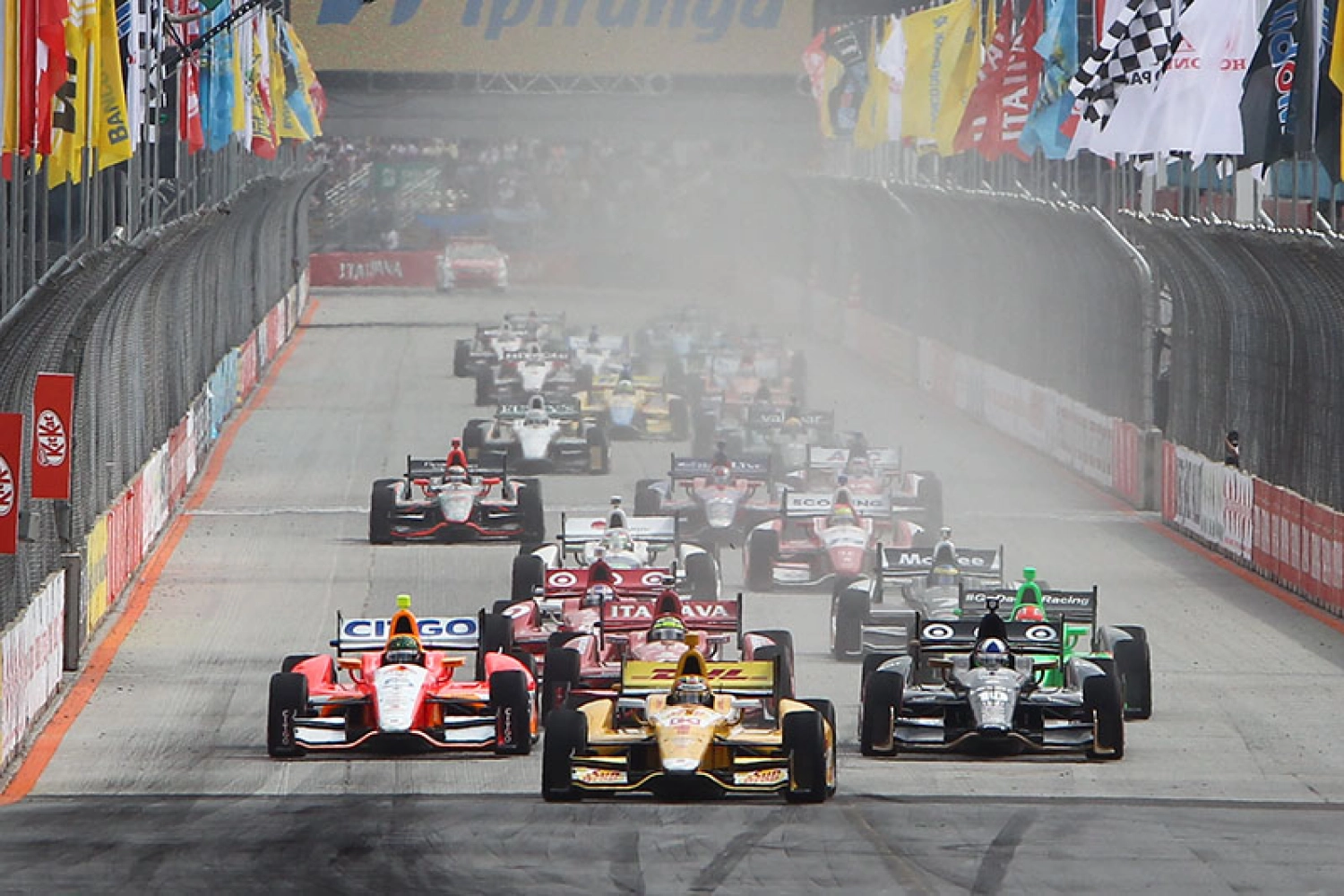
IndyCar is THE single-seater competition in North America. It has gone by different names over the years… and through the splits. In 2008, Champ Car and IRL merged to give birth to IndyCar. What makes it interesting?
The circuits
Everyone knows the Indianapolis 500. This one-of-a-kind race, on a 4 km long (rectangular) oval, is one of the oldest races in the world. But the 2015 IndyCar calendar isn’t just about left turns. Ovals make up a third of the races, road courses (on circuit) represent another third, and the rest are street races, with little space and many concrete walls.
The unique chassis
As in single-make series (GP2, Formula Renault 3.5, etc.), the Dallara chassis is common to all competitors. A unique chassis ensures a closer performance among the entire field. It is heavier than a Formula 1, less agile, but advanced enough to provide entertainment… and incidentally for the drivers to have fun.
The engine: the power
There are two engine manufacturers, Honda and Chevrolet. On paper and on the track, the performances of the two 2.2-liter twin-turbo V6 engines are very close. They are limited to nearly 700 horsepower on road circuits and 550 hp on the large ovals, the super speedways. Even when restricted, these engines still allow speeds of over 380 km/h.

The engine: the sound!
It’s really different from Formula 1: the feeling of power from a car (especially a racing one) is a crucial criterion in the United States. Since its introduction, the V6 has never been criticized on this point. For 2015, the exhausts have been reworked to enhance the image of power and performance of the single-seaters.
The engine: Push-to-Pass
The Americans don’t bother looking for names; the Push-to-Pass is simply a button located on the steering wheel that you need to press to gain a few extra horsepower to overtake an opponent. There is a quota of 10 Push-to-Pass in a race (except on oval tracks).
Aerodynamic kits
The big new development this year is the introduction of specific aero kits for each of the brands. Chevrolet and Honda have developed two different visions of the aerodynamics of their cars. However, in the end, during pre-season tests, the performances of both manufacturers were quite close despite a slight dominance by Chevrolet.

The pilots
Here… we’ve got something big. In 2014, there were 11 different winners across the 18 races on the IndyCar calendar. During the Barber tests last week, less than a second separated the fastest driver from the 21st place!
In the list of registrants, we find:
– Scott Dixon: 35 victoires et 3 titres IndyCar,
– Sébastien Bourdais: 32 victoires et 4 titres de Champ Car,
– Will Power: 24 victoires et champion 2014,
– Helio Castroneves: 29 victoires dont 3 fois les 500 miles d’Indianapolis,
– Juan Pablo Montoya: 12 victoires, champion CART 1999 et 7 victoires en F1,
– Tony Kanaan: 17 victoires et champion 2004,
– Ryan Hunter-Reay: 14 victoires et champion 2012.
It should also be noted the presence of:
– Simon Pagenaud: nouvel arrivant chez Penske, la plus grosse équipe du plateau. Le Français a joué le titre lors des 3 dernières saisons,
– Stefano Coletti: venant du GP2, le Monégasque a impressionné tout le monde, lors des essais d’avant saison, par sa rapidité à exploiter une nouvelle machine sur un circuit qu’il ne connaissait pas,
– Takuma Sato: le Japonais a 90 départs en Formule 1,
– Simona de Silvestro. La Suissesse revient d’une déception en Formule E et trouve refuge dans l’écurie Andretti Autosport. Elle aura sans doute la meilleur voiture de sa carrière en IndyCar.
These brave folks can be followed from Friday, March 27, during the St. Petersburg GP trials, streaming (official) on YouTube: https://www.youtube.com/watch?v=X2vT5bIaiBA and on https://racecontrol.indycar.com/
The Grand Prix will be broadcast live on Sunday evening on Canal+ Sport.