IndyCar: Technical Characteristics & New Features 2015
The 2015 IndyCar championship begins on March 29 in Florida, with 23 cars registered. There is still a common chassis, two engine suppliers, one manufacturer... but the formula that made the 2014 season successful will nevertheless evolve somewhat.

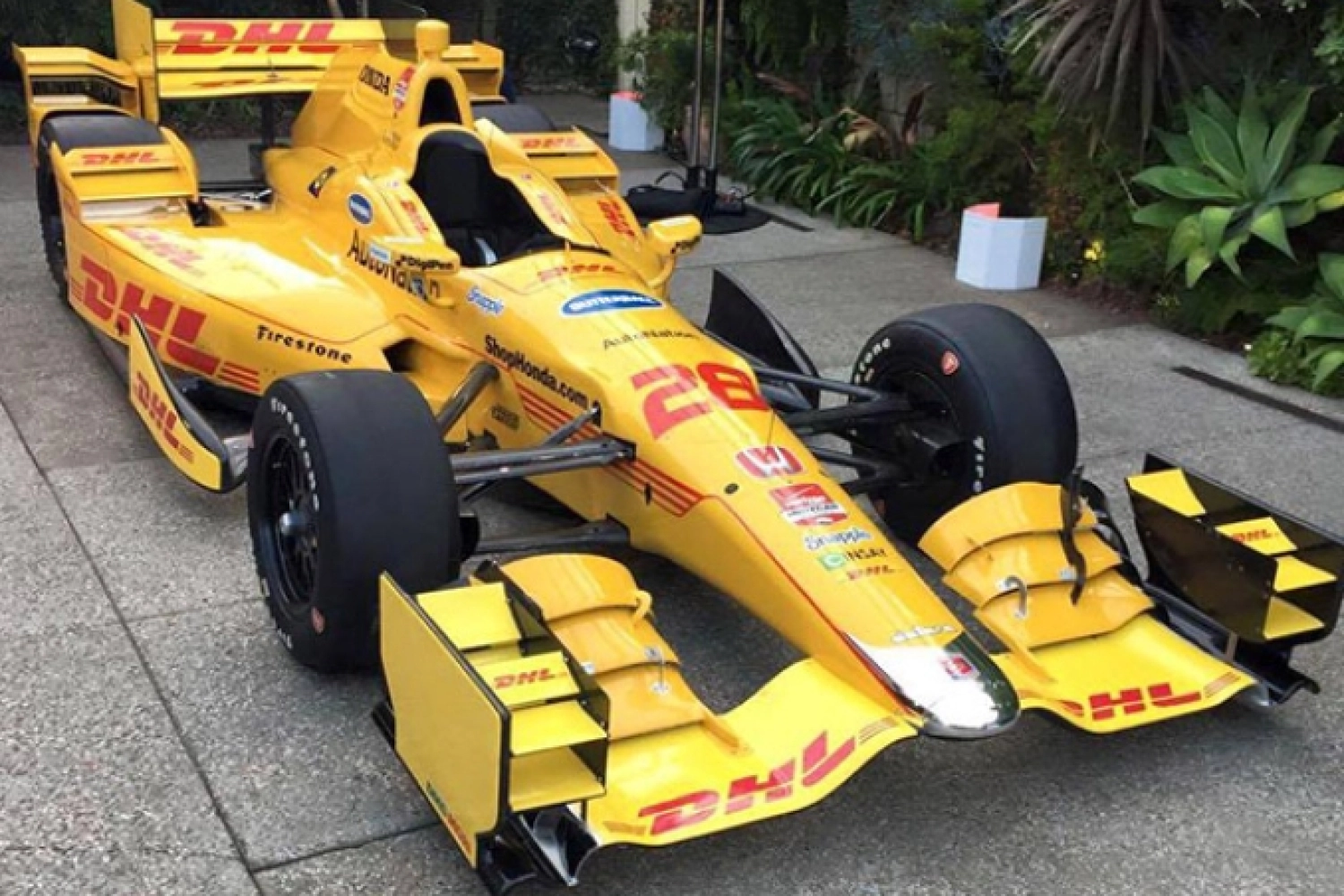
The new season continues in the same vein… but not quite! The show’s executives want to reassure participants and advertisers while spicing up the competition with the authorization of aerodynamic kits.
« The best thing an organization can provide to competitors, constructors, and fans is a consistent and stable set of regulations, so most of the changes for 2015 are clarifications and an ordering of definitions, » indicates Derrick Walker, the Director of Operations and Competition for IndyCar: « The regulations are continuously evolving, and we are always looking to refine them to make [IndyCar] a better product. »
The chassis
The single chassis recipe has contributed to spectacular shows in recent years. It remains the Dallara DW12, named for “Dan Wheldon 2012,” in honor of the 2005 champion who died during the last race of the 2011 season. The English driver had participated in the development of the chassis designed and manufactured by the Italian brand. The car weighs about 700 kg on speedways (such as Indianapolis) and 715 kg on road courses, street circuits, and short ovals.
Dallara is the largest manufacturer of racing chassis, present in about ten disciplines, particularly in single-seaters (GP2, GP3, Formula E, etc.).
One of the striking features of the 2012 single-seater design is undoubtedly the bodywork element behind the rear suspension, intended to prevent wheel entanglement between two cars… an element that would likely have reduced the severity of the multiple car crash in Las Vegas in 2011, during which several cars became airborne at over 250 km/h and in which Dan Wheldon was killed.
Tires
Firestone is the sole manufacturer for the discipline. Present since 1996 on the race cars participating in the Indianapolis 500 miles, the American brand offers three types of tires on race weekends: the “Primary” (slicks, completely black) for all races, the “Alternate” (soft compound slicks with red sides) for city and road course races, and the “Rain” (grooved) for rainy weather on city and road circuits (oval races are only contested in dry conditions).
The engines (data 2014)

© Honda HPD HI14TT
Chevrolet and Honda have shared the grid since 2012 and the return of the American brand to single-seaters (except for Lotus’s failed attempt that same year). Both engines are 2.2-liter twin-turbo V6s, developing a maximum of 700 hp (estimated) and restricted according to the circuits by pressure from the Borg Warner turbos:
– sur les speedway: 575 ch / turbos à 1,3 Bar
– sur les ovales d’1,5 mile: 625 ch / turbos à 1,4 Bar
– sur les routiers: environ 675 ch / turbos entre 1,5 et 1,6 Bar
The maximum revs range between 10,500 and 12,000 rpm (imposed limit). In city and road races, a provision of 10 Push-to-Pass allows drivers to get a turbo boost of 161 Kpa and an additional 200 rpm in max revs. Once they press the button, they benefit from this overtaking aid for 15 to 20 seconds depending on the circuits… as long as they keep their foot on the accelerator. These Push-to-Pass can be used at any time during the race.
In terms of electronics, both manufacturers use the TAG 400i from McLaren Electronics. The sequential gearbox is an Xtrac 1011, 6-speed with paddle shifters plus a reverse gear. The fuel is E85 (85% Ethanol).
The bodywork
In general, the bodywork of a single-seater is not separated from its chassis, but that is no longer the case today. Starting this year, the two engine manufacturers each offer aerodynamic kits, approved and fixed for the entire year, different from those of Dallara. This is the big novelty. There are still two types of kits: one is designed for street races, road circuits, and small ovals (requiring aerodynamic downforce), and the other is adapted for “speedways,” the large ovals like Indianapolis with low downforce favoring speed.
These new kits will allow both a greater range of configurations and finer tuning for the balance of the single-seater. Drivers will be able to remove or add components of the complete kit, at their discretion, to fine-tune the settings.
Walker has already warned that in the event of significant performance differences between the two manufacturers, the one at a disadvantage will be granted a waiver to develop their kit during the season.
Regulatory developments
Standing starts are abandoned for 2015. The reason cited by Derrick Walker seems to be safety: « On most circuits where we race, only a handful meet the width criteria for our cars, which are larger than most single-seaters. » We remember the terrible crash at the start of the Indianapolis GP, when a back row car couldn’t avoid the poleman, who was immobilized at his spot. « There is a need to evolve the starting procedure. I wouldn’t say it’s definitive. We know the fans love it, and so do we, » adds the director of competition.

© IndyCar – Accident au départ du GP d’Indianapolis 2014
This year, two races will award double the points of a normal race. First, the Indianapolis 500 miles; it’s a unique race, similar to the 24 Hours of Le Mans in the World Endurance Championship. The second event to benefit from this scheme is the one that will conclude the season on the Sonoma road course. The organizers want to increase the suspense by giving as many drivers as possible the chance to be mathematically in a position to win the title. This is confirmed by Walker: “We looked at the new calendar and analyzed how many cars could be in contention for the championship after certain events, and the best solution with several cars competing for the championship was to weight it for the final race and the Indy 500, which is a special race deserving double the points.”
The qualifying groups during road and street races will be determined by the classification of the free practice session that will immediately precede the qualifying.
The qualifications define the order of obtaining spots in the stands for the next race. Starting this year, in the case of multiple drivers for the same car, it is the last qualification in which the driver participated that is taken into account, not the last qualification of the car… potentially driven by another driver.
The aptitude test for the Indy 500
The speed of the three phases of the Rookie Orientation Program for the Indy 500 will be increased by 5 miles per hour. All newcomers to the Indianapolis 500, even if they are Formula 1 world champions, must undergo consistency tests. The first phase consists of completing 10 laps between 205 and 210 mph, the second phase is 15 laps between 210 and 215 mph, and the third is 15 laps at a minimum of 215 mph (346 km/h).

© IndyCar – Ryan Hunter Ray vainqueur de l’Indy 500 en 2014