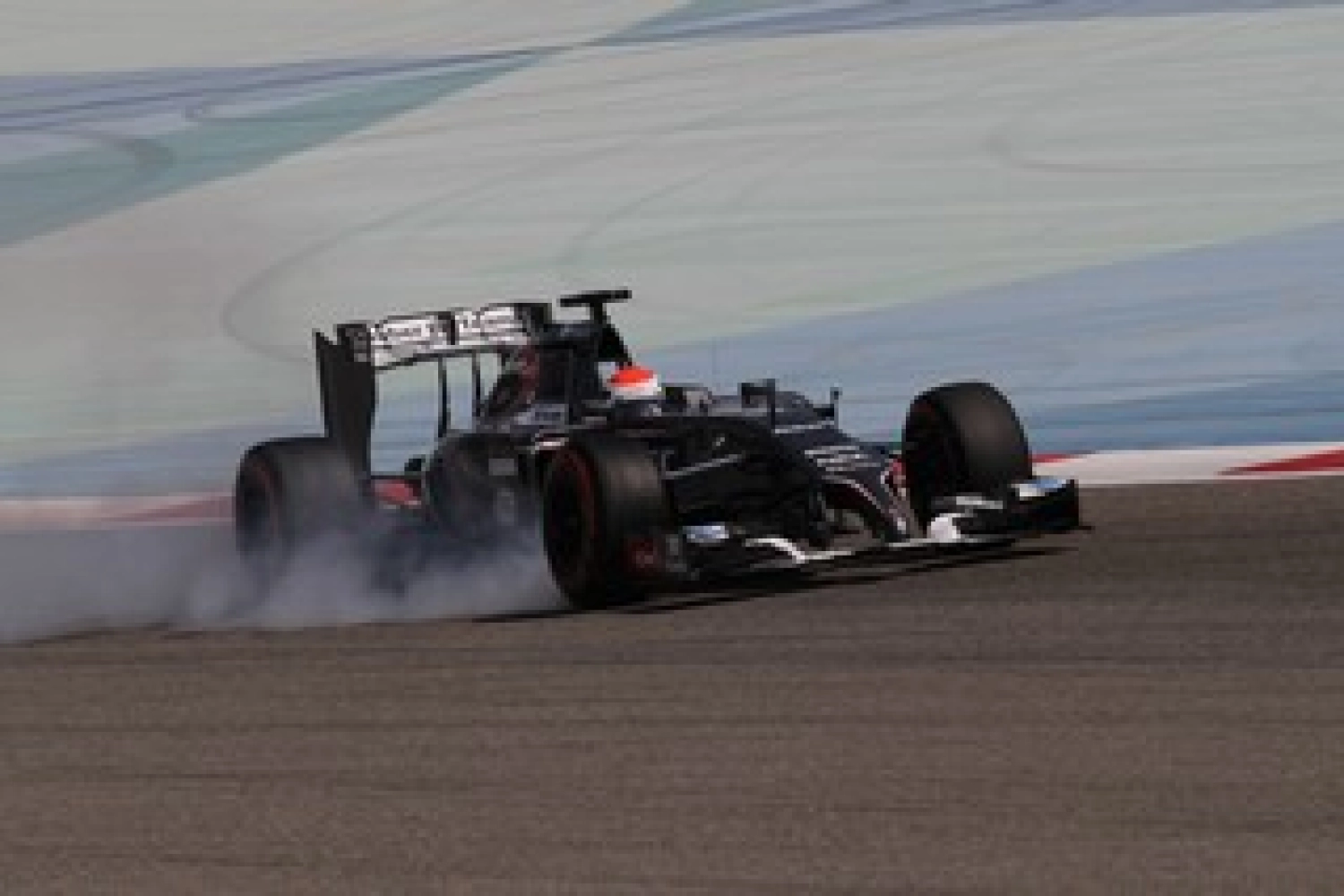
Brembo reveals the secrets of braking in F1
Andrea Pellegrini, the Brembo engineer at the Grand Prix, received us during the Monza weekend to explain everything about the functioning of brakes in F1 and the brand's involvement in the sport.

To facilitate his demonstration, the engineer brought a complete set of brakes. He began by detailing all the components that make up a brake, on a single-seater as well as on a production car. The largest part is obviously the disc itself. On an F1 car, it is 100% carbon. The advantage of this material in competition is that it has a very high-temperature range: « These brakes start working well from 250-300°C and can rise to over 1,000°C. »
However, these brakes are not about to make their appearance on production vehicles: « But below these temperatures, their effectiveness is very limited. This can cause the sensation that they are frozen. That’s why we don’t use carbon brakes for our production vehicles: on a production car, you need your brakes to be operational even at very low temperatures. For example, to stop at a red light in the city. »
The teams are required to customize the calipers because the design of the caliper can only be created on a case-by-case basis, in consultation with each team. Indeed, it must adapt to a setup that each optimizes as they see fit. A team might choose to have a less resistant caliper that has the advantage of being lighter. Similarly, the mountings are not the same. Therefore, we cannot use a team’s caliper for another.
Similarly, the teams make trade-offs on the number of pistons they use: « The maximum allowed by the regulations is to have six pistons. However, some teams choose to have only four pistons at the rear. But all choose to have six at the front. » Indeed, the more pistons are present, the greater the braking pressure.
Brakes are also among the components on which it has been possible to reduce costs in recent years. Indeed, Brembo now designs only one caliper at the front and one at the rear for each team for the entire season. These two components are therefore identical for each circuit of the season, even though these circuits present very different characteristics in terms of the braking required.
The last element presented is the master cylinder. Each single-seater has one for the front axle and one for the rear. They are connected to the pedals, on which the drivers press: « The effort they put into the pedals is impressive since they can apply up to 160 kilos of pressure with just their foot! Ultimately, this translates into a pressure that can reach 100 bars in the caliper, where the pistons engage the pads. » In braking situations like the first corner at Monza, this allows single-seaters traveling at nearly 340 km/h to slow down to 85 km/h in less than 150 meters during a braking maneuver that lasts no more than 2.5 seconds!
A circuit like Monza thus presents seven major braking zones, but they are each separated by long straights, which allow the brake disc temperatures to drop quickly. On the other hand, in Budapest, the energy that the brakes need to dissipate is much more limited, but the brakes are used very often for low-energy braking. This causes a constant increase in disc temperature.
This increase in temperature within the disc and brake fluid is problematic since it leads to the expansion of the material, which becomes less hard. However, if this material becomes less hard, the feel in the pedal is no longer the same for the driver. If the driver starts to lose their braking reference points to compensate for a pedal that responds less strongly and therefore feels longer, they will lose confidence in their car, and their performance will be directly affected.
If Brembo supplies the same discs to all its customer teams, they can choose to customize it in their own way: « A team can choose to personalize the number of holes on the edge of the disc. These holes are used to cool the disc to prevent it from overheating. The number of holes varies depending on the race, but they can reach over 1,000. For races like Sao Paulo or Suzuka, it’s not necessary to have so many. Some circuits, like Spa or Silverstone, even allow for narrower discs to save weight. »
Nevertheless, this disk optimization strategy runs into financial considerations. Indeed, while Brembo has been present in the paddocks since 1975 and has always been a partner of Scuderia Ferrari since then, it also supplies Mercedes, Red Bull and its little sister Toro Rosso, Sauber and Caterham: « If you choose to have more types of disks, it increases the number of spare parts you need, impacting the team’s budget. Some teams thus have the same disks throughout the entire season. »
If the Italian company provides six teams, the team that travels to the circuits is very limited: « Depending on the circuit’s brake requirements, one or two of us are present. But at the headquarters, we have a team dedicated to analyzing this data, another responsible for design, and others for production. »
The analysis team was recently busy explaining the failure encountered on Lewis Hamilton’s car during the German Grand Prix qualifying, the causes of which were explained during the Belgian weekend. The engineer did not want to go into too much detail but explained that some teams, without naming them, could take the responsibility of manufacturing their own wheel attachment that integrates into the disc. Brembo recommends a safety margin, but teams might be tempted to slightly exceed it to gain performance: « The wheel attachment is made of titanium, while the disc is made of carbon. However, carbon is both very resistant to heat but also very fragile. It is therefore important to balance the weight and geometry of this element because if it is too light, it will expand in volume, causing mechanical stress on the disc. »
You can find a summary of how the brakes functioned in 2014 in the video below, created by the Italian brand to illustrate the impact of its work:
From our special correspondent in Monza