Tata presents its strategy for its presence in F1
Present in the British paddock, we went to meet Mehul Kapadia, the head of F1 at Tata Communications, to have him explain his company's strategy regarding its investment in F1.

Since the start of the 2012 season, Tata Communications has been the official F1 telecommunications provider and hosts the official site Formula1.com. It is therefore at the heart of the data generated by Formula 1: « When we first arrived in F1, we initially focused on the connectivity aspect. We improved their infrastructure by more than ten times compared to what they were using before. We connected all the circuits around the world to their headquarters in the United Kingdom. Thus, we have cameras on the circuits that are remotely controlled from this headquarters. »
Hosting the official F1 website is also an important responsibility since the site must be able to handle the influx of visitors during race weekends. Therefore, up to seven million people may attempt to access the site simultaneously: « During race weekends, the traffic experiences a real peak. The infrastructure we provide them must be able to scale up very quickly. »
Agreement with Mercedes
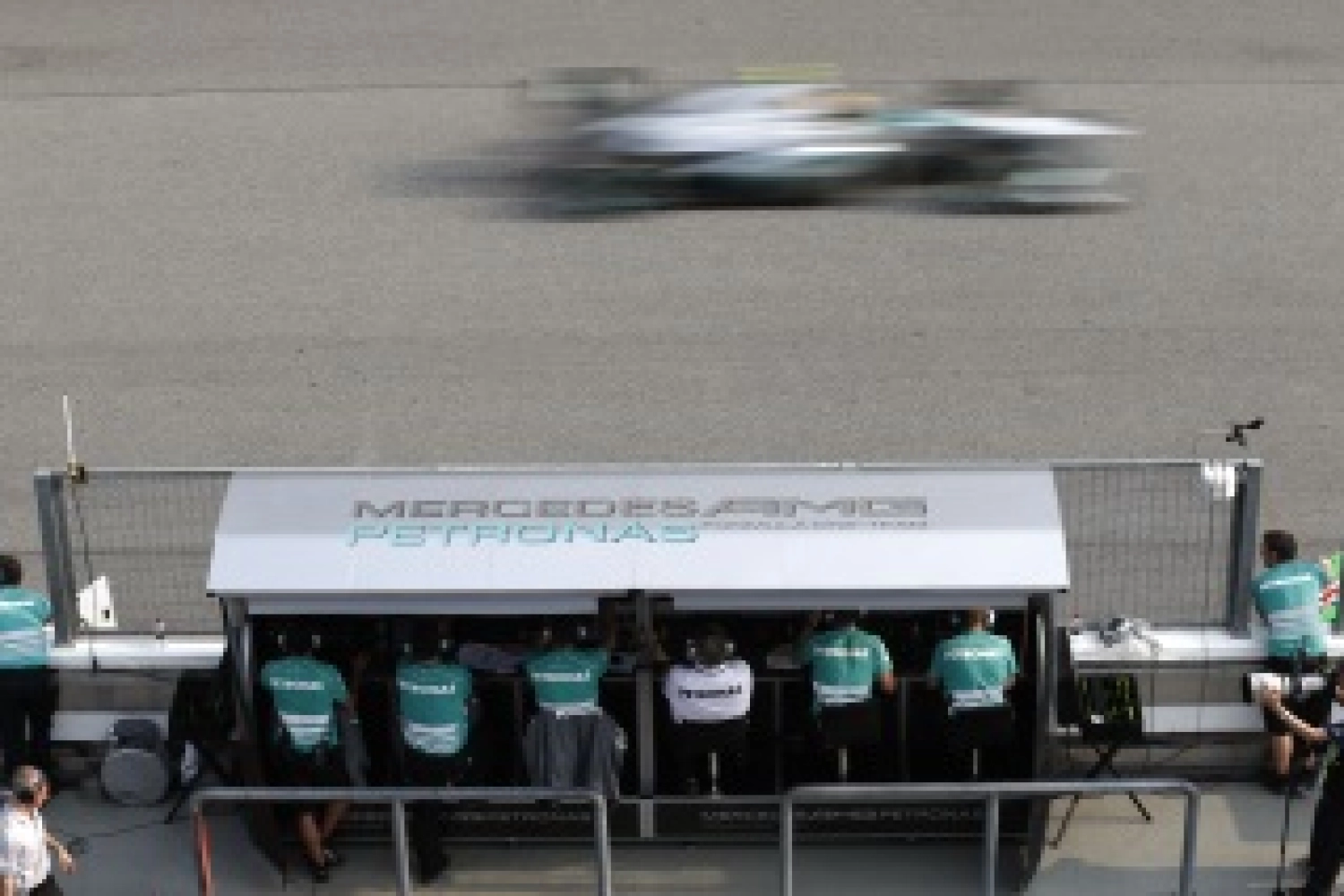
One year after this agreement with FOM, Tata Communications also entered into a close collaboration with Mercedes. Tata had been able to demonstrate the interest of its technology by being a partner of the sport in general but wanted to have links with a team to show its effectiveness at another level of the sport: « For us, it was a great opportunity to work with a team because F1 presents its own tuning opportunities, but the teams also present adjustments unique to them. »
The services that are then offered are the same as those Tata had proposed to the FOM, namely the network capable of connecting the track with the headquarters: « We also provide them with connectivity technologies that allow their engineers to make quick decisions from their headquarters in Brackley. This therefore directly contributes to their on-track performance. »
A platform to showcase one’s expertise
But Tata Communications did not stop at these two levels of sport, as for the 2014 season, an agreement was made with the Dutch television channel Sport1 to provide it with images via its fiber optic network. Tata is therefore present at all levels of F1 because sport is at the heart of its strategy: « For us, F1 is a true platform. It’s not about having a single service or a single type of connectivity. It’s truly about being present at all levels, from those who own the sport to those who have a team, to those who deliver the content directly to the fans. We are therefore able to provide a whole portfolio of services. For us, it becomes a very powerful commercial slogan: “If we are able to do it for Formula 1, we are able to do it for everyone, everywhere, and all the time.”
Tata Communications’ presence in F1 is therefore at the heart of its global strategy: « It’s very important to us. It’s a truly global sport, it goes to many countries, including emerging ones. The most important thing for us is that it allows us to do and show what we can do rather than just talk. It’s a very important message to a potential client: no matter where you need my services in the world, be it in Japan, Brazil, Australia, or Bahrain, we can do it. For us, it’s about doing first, then talking about it rather than just putting a logo on a car. »
A fairly small and geographically dispersed team
It is also interesting to see how Tata Communications is involved in F1. Indeed, as a telecom company, it claims that many things can be done remotely. It is therefore leading by example and implementing what it advises its own clients: « We have a team of about fifteen people who work from the United States, the United Kingdom, or India. And we have three people who travel to the races. We have Team A and Team B. This way, when there are two races in consecutive weeks, the same team doesn’t need to attend both. During the different sessions, all these people are on deck because we have to ensure that everything works as expected, at the expected time. »
The Tata Group as a whole and Tata Communications, in particular, are companies that originated in India but have clearly become multinationals that do not depend on any particular country. This means that it has not been a significant loss to not go to India: « It does not impact our credibility if we are no longer in India. What matters is that we can demonstrate our performance in these other 19 destinations. »
From our special correspondent in Silverstone