Tamburello corner: “That damn wall… one day someone is going to die”
The tragic events of this 1994 San Marino F1 Grand Prix sadly did not surprise everyone. Drivers have known for several years that this track is dangerous. Some had bitter experiences there before the tragedies of Ratzenberger and Senna...

We are in 1994. The Autodromo Enzo e Dino Ferrari is a circuit built in the early 1950s. It is one of the few circuits that run counter-clockwise. Even before its construction, Enzo Ferrari nicknamed it “the little Nürburgring”. Over time, the addition of chicanes hasn’t taken away the very essence of this circuit: speed, the strain on the mechanics and the driver.
This hilly course quickly sets the tone: the first turn is a large left-hand curve, bumpy, taken flat out at nearly 300 km/h: the dreaded Tamburello. It is followed by a right-hand curve, no less fast and no less dangerous: the Gilles Villeneuve curve. It owes its name to the violent crash of the Canadian during the Grand Prix in 1980. That same season, during testing, it was the reigning Champion’s Ferrari, Jody Scheckter, that went straight into the wall. It is at this same spot that Roland Ratzenberger meets his end.
Imola hosts two non-championship Formula 1 races in 1963 and 1979 before becoming the Italian Grand Prix in 1980, during the refurbishment of Monza. Its success leads to the organization, starting the following year, of the San Marino Grand Prix, the third smallest republic in Europe, even though it’s an hour’s drive away.
Technology faster than infrastructure
Year after year, Formula 1 cars are getting faster and faster; more aerodynamics, more power, and better suspensions. In 15 years, the cars have gained several tens of kilometers per hour in top speed, and even more in cornering speed.
Many circuits no longer meet the requirements of modern single-seaters. But F1 has become safer… or perhaps it’s simply luck that has spared us tragic fates.
Until 1982 and the deaths of Gilles Villeneuve and Riccardo Paletti, the grand circus mourned the loss of one to two drivers per year on average. The death of Elio de Angelis in 1986, during private testing, almost went unnoticed. It did not have the impact of an event covered by television.
Thus, in 1987, the impressive accident of Nelson Piquet at Tamburello did not lead to any reconsideration of track safety. However, the Brazilian’s Williams violently hit the wall during qualifying after losing control. He left the hospital with minor injuries considering the impact, but serious enough for the doctors, led by Sid Watkins, to prevent him from racing in the Grand Prix. Even though the driver smiled in interviews, he admitted to closing his eyes during the crash.
« I felt my whole body burn »
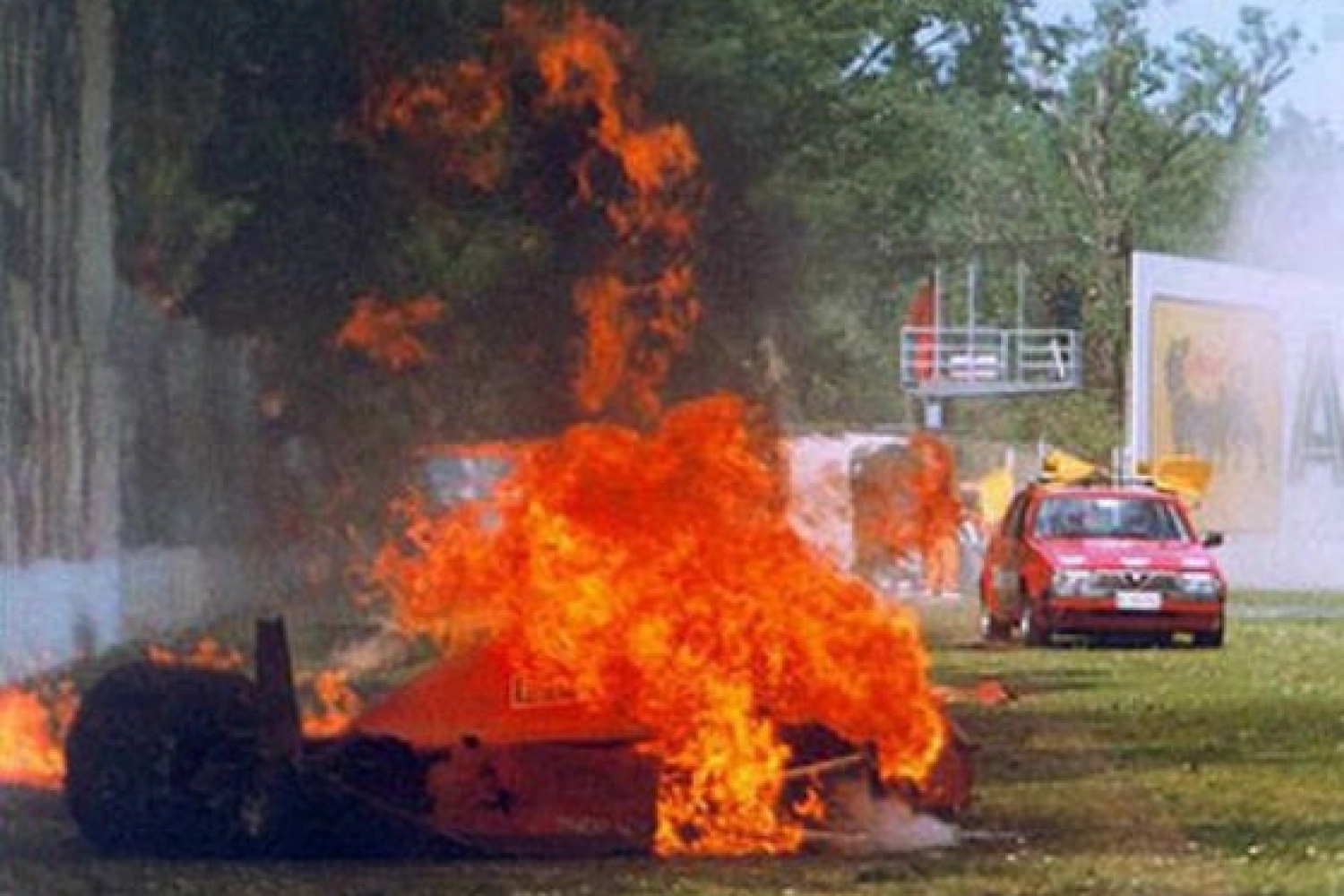
In 1989, the accident occurred that would finally raise questions, including those of Ayrton Senna. At the very start of the race, in that infamous curve, Gerhard Berger’s Ferrari went straight into the wall. I turned at Tamburello, I immediately understood that something was wrong. The Austrian had just lost his front wing. That’s when I saw that the car wasn’t turning and was going straight, then I saw the wall approaching, and I remembered that my fuel tank was full. I thought I was going to die.
Despite the driver’s braking reflex, the Ferrari hits the wall at nearly 300 km/h, disintegrates, spins on itself from the impact’s violence, then ignites. I was in a lot of pain, I felt my whole body burning. I was covered in gasoline, which at that time was very corrosive. Berger waited a long, harrowing 16 seconds before being rescued and “undergoing” the first aid: the tube in the throat and the respiratory assistance were even more painful than the accident itself. Many people called me. I spoke to Ayrton. I told him that I was okay, I didn’t really know what had happened. But I told him: “That damn wall… someday someone is going to die because it’s way too close to the track.” It’s such a fast turn, if you have a mechanical failure, you’re dead.
A few weeks later, the two men return to the site. They both notice the presence of the Santerno River, which prevents the wall from being moved back. « We said to ourselves that we couldn’t do anything. He died exactly at the spot where we were talking »
A career-breaking track

This accident led to a realization for the Austrian driver: « I have previously experienced putting two wheels on the grass to overtake two cars in a straight line on the old Hockenheim. I thought “oh, it will work”. Later, I tried with four wheels on the grass, and obviously, it didn’t work. I have always been committed to taking risks. From that moment (the accident) I thought: it can be very painful. To be honest, after that, I never reached the performance level I had before. »
Gerhard Berger was Ayrton Senna’s friend. When the Imola Grand Prix restarted after the tragic accident, the Austrian driver could not continue his race and had to stop due to emotion. Another man did not get back behind the wheel after the GP interruption. It was Erik Comas. Two years earlier, in Belgium, Ayrton Senna saved his life by assisting him after a violent crash.
On this May 1, 1994, an error by the track marshals led the Frenchman to find himself right behind the wreck of Senna’s Williams and the doctors’ helicopter: « It was as if an atomic bomb had just exploded at Tamburello. There was a very heavy atmosphere that descended on the place, and without knowing the details, I knew it was very bad. I found myself paralyzed because I was next to a man who had saved my life two years earlier, and I couldn’t do anything to help him. It’s a terrible feeling. » He would leave Formula 1 at the end of the 1994 season. His dream of driving in the premier category died along with the man he admired.
The Imola circuit was redesigned following that dark weekend. The three corners where the accidents of Barrichello, Ratzenberger, and Senna occurred were slowed by chicanes. In 2006, the infrastructures no longer met the FIA’s safety requirements. The Autodromo Enzo e Dino Ferrari, forever marked by tragedy, will no longer host Formula 1 Grand Prix.