Renault facing “electrical” issues in Jerez
The teams powered by Renault have been in trouble since the start of the private tests in Jerez. The issue lies with the electrical supply being too fragile on the new V6 Turbo engine, which has forced Renault to take precautions. The problem is expected to be resolved tomorrow thanks to new parts developed just before Jerez.

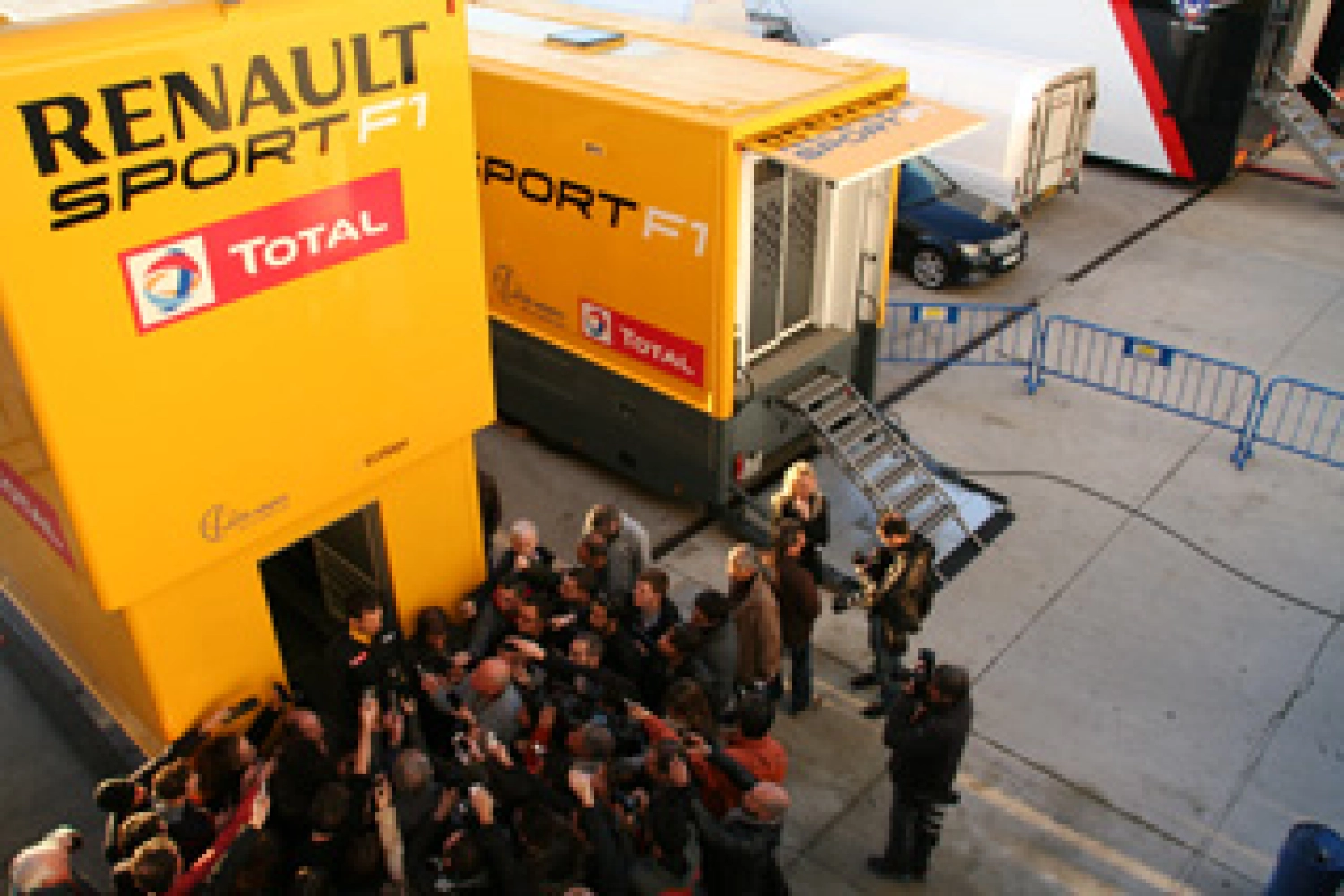
Renault held a press conference with Rémi Taffin on Wednesday evening in Jerez, after the second day of winter private testing. The French engine manufacturer was indeed responsible for the three mechanical issues encountered by Red Bull, Toro Rosso, and Caterham today, which means all the teams powered by the firm except for Lotus, who was absent from this first week of testing.
Rémi Taffin admitted that the problems faced by these three teams were mainly caused by Renault’s new engine system. More specifically, it’s the electric power supply that is to blame: It’s something that takes a long time to fix. However, we had the necessary parts here to repair it. The only problem we have is that it’s an operation that lasts a few hours, explains the head of track activities at Renault Sport F1.
The Frenchman continued: « Taking the example of Toro Rosso, we didn’t have the necessary time to repair and allow them to run. At Red Bull, it was different because we were able to run this morning but not in the way we wanted since we don’t fully understand the system’s functioning yet, and so we decided to stop. »
The premature stoppage of today’s tests for the Renault teams will thus allow them to repair the parts to provide the teams with the best possible configuration for tomorrow’s run.
This mechanical issue is not caused by a specific part but by the system not functioning in a particular configuration. The problem can be compared to a “circuit breaker” that, when the car is in a certain configuration, must “trip” to avoid any problems. The configuration is unique to each team, so the issue differs from one team to another, but the origin is always linked to the same element.
« It’s not a problem with a specific part. We test them side by side on the test bench. It’s more about the architecture and the systems all mixed together that mean when we arrive in a new environment [Editor’s note: a new single-seater], we might have slightly different tolerances, and in those cases, we have to protect ourselves from that and thus have components or hardware that are more robust – something we’ve brought here and need to have on track tomorrow. »
Rémi Taffin nevertheless believes there are positive points. Indeed, these mechanical troubles are being detected now and have been easily identified, which allows us to keep moving forward: Resolving this issue for everyone starting tomorrow is well worth all the kilometers lost today. […] It’s not necessarily an unexpected problem since we are capable of dealing with it today. But we must be aware that the real challenge is to get everything working together in a different environment depending on the team.
Renault has indeed validated its system on the test bench but continues to develop its system in real conditions: « We are in a development process. The parts were produced about fifteen days ago and in the meantime, we have continued to develop the engine. On the test bench, the latest specification did not warrant working day and night to have new parts in Jerez, but we got them later as part of the development process. We had them “just in case. »
The teams powered by Renault will therefore address a major issue to move forward in their development. Nevertheless, the Mercedes and Ferrari teams, among others, had the opportunity today to test more than just the engine systems thanks to the numerous laps completed. This valuable time is already lost for these teams.