Luca di Montezemolo wants a collegial governance of F1
While the traditional Wroom event in Madonna di Campiglio was not renewed for 2014, Luca di Montezemolo took advantage of the year-end holidays to gather the press in Fiorano to share his vision for the future of F1. For him, it will be necessary to have multiple leaders to replace Bernie Ecclestone.

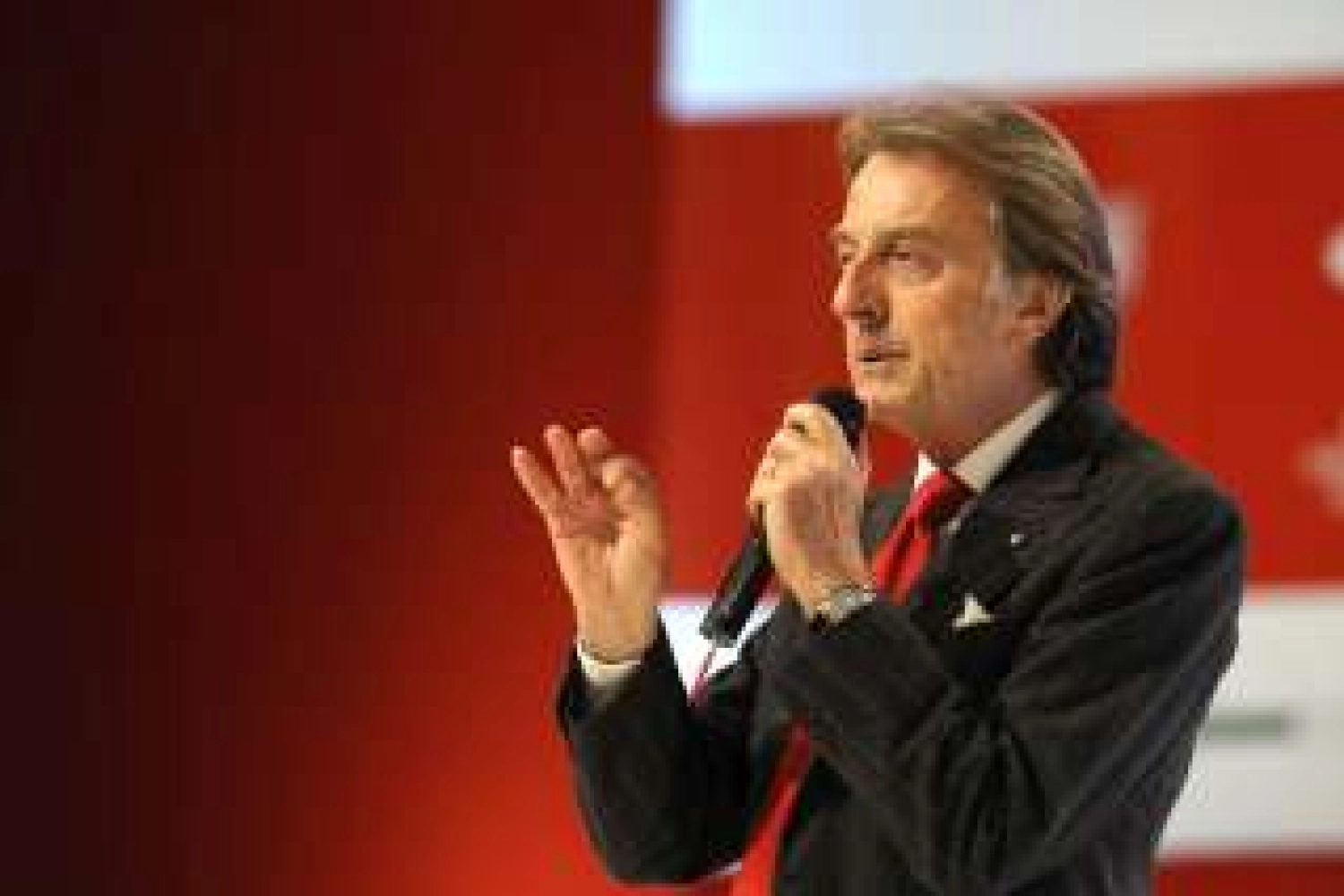
F1 as we know it today was largely shaped by Bernie Ecclestone, who is at the heart of all the sport’s financial discussions. Nevertheless, at 83 years old, his succession is increasingly on the minds of everyone involved in the sport.
Even if the different stakeholders have just signed new Concorde Agreements, their duration is not unlimited either. For the Ferrari leader, finding a new Bernie is simply not conceivable: « I often talk with Bernie Ecclestone: as long as he’s there, there will be a certain form of management. But when, sooner or later, his time will be up and the structure will also change. There will no longer be a number one but a structure with someone filling a role similar to that of a corporate CEO. It’s true that we have a commitment until the end of 2020, but we are already at the beginning of 2014. So there isn’t that much time left… »
The new management structure at the head of F1 could take the form of a CEO, supported by a technical director and a director of sporting and commercial affairs: « I think after Bernie, who is unique, it is necessary to have a new governance for the sport. Bernie is Bernie, with a lot of strengths and even some weaknesses, like all of us. I hope for him that he can stay for a long time but it’s not just a problem for today. We need to discuss the succession plan because, in the end, it’s our business. It’s not about putting a Rob, a Jon, or a Mario after Bernie. The question is how we approach it. You have to consider commercial issues, TV rights, and where to race. »
For Luca di Montezemolo, there is no point in going to countries without a passion for F1 since if there are no fans attending in the stands, the teams are not able to engage with them. A reset of the calendar’s destinations would also need reviewing to ensure that the new generation is also interested in F1: « I am tired of going to races in the middle of nowhere where there is no audience. What relationships do we have with the public? We have been talking for several years about new technologies and what we can do to improve the show, but there is no doubt that young boys like cars and F1 less. One of the reasons, but not the only one, is that the races have become harder to follow. We need to work with the media, television, radio, print press, and the Internet to find out what the right approach is. As long as Bernie is there, Bernie knows it. He is smart but sometimes he is a bit too conservative. But he is Bernie, and I will never accept that instead of Bernie, there is just one man, Luca di Montezemolo or someone else. We need to create a governance group where there is a CEO and someone in charge of motorsports, but motorsports do not mean regulations. It means many paths participating. »
The comments of the Italian president regarding the place of F1 in traditional and social media are reminiscent of what Adam Parr used to say when he was still at the head of Williams: « The story we have for creating a global audience, the quality of television images, race direction, which is a very difficult task, is incredible. It’s world-class. What I believe is that social media, the Internet, and even pay TV have developed so much in the last decade that we must change our perspective. Not only in how we communicate with people and distribute our content but also economically if possible. »
A name that is being mentioned more and more often to take on the role of F1 CEO is Ross Brawn. Indeed, the Brit has experienced everything in F1: world championship titles as a technical director (with Benetton and Ferrari), then as an owner and team manager (Brawn GP). He has just left his position at Mercedes, where Toto Wolff and Niki Lauda are becoming more influential as team shareholders. His close relations with the FIA (where Jean Todt was re-elected as president) and major teams (Ferrari, Mercedes, etc.) also contribute to a potential candidacy.
While waiting for Ross Brawn to possibly come out of his sabbatical, Luca di Montezemolo suggests that all the teams gather around the same table to discuss the future of F1 and make decisions that are best for the sport because what is good for the sport should be good for its participants: “I think it’s time for all of us to sit around the table with the other teams to discuss the general approach to Formula 1, and with that in mind, I want to organize a meeting in the second half of January, here in Maranello. I want to discuss constructively, not discussing competition at all, but presenting proposals transparently, without under-the-table agreements. There should be more dialogue between teams when it comes to discussing problems affecting Formula 1.”
The lack of unity among F1 teams has indeed allowed Bernie Ecclestone to completely control the F1 value chain, in which shareholder investment funds obtain a larger share of the profits than the teams. This, therefore, leaves teams, competitive ones like Lotus, in significant financial difficulties even though F1 has never been in better commercial shape. But is Luca di Montezemolo ready to question his team’s veto right on the future of F1 or their special percentage, negotiated thanks to their status as the oldest team on the grid?
With the participation of www.Racingbusiness.fr