United States: Figures and Technical Data
A brief overview of the technical constraints imposed by the Austin circuit in the United States on the chassis, engine, and tires of Formula 1 single-seaters.

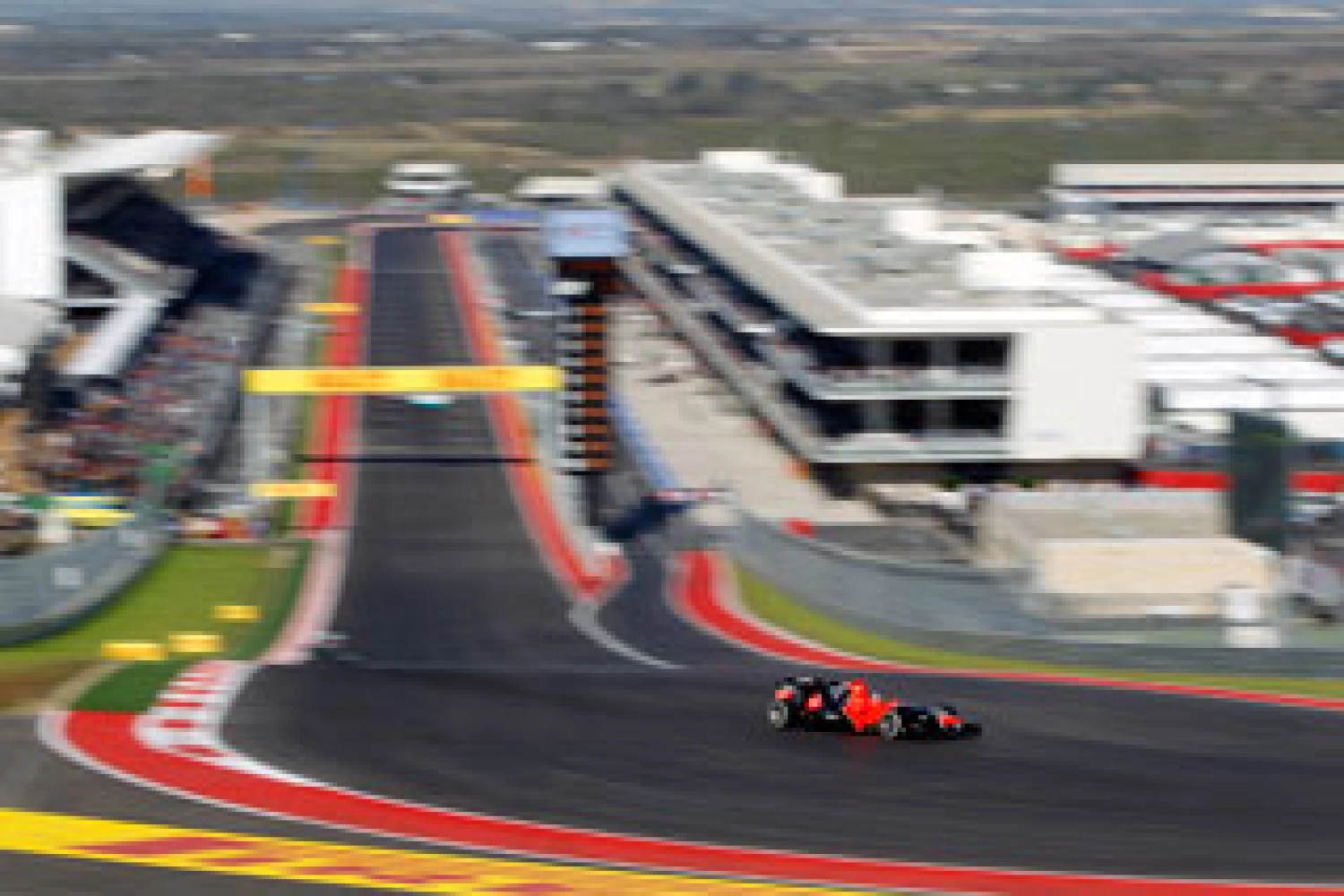
This weekend, Formula 1 heads to Austin for the second United States Grand Prix held on the Texan track. The Circuit of the Americas, located near the capital of Texas, is the 10th venue to host a United States Grand Prix. The track is quite appreciated by the drivers, notably due to the changes in elevation it includes.
Once again, there will be no American driver on the grid this weekend in Austin, even though Alexander Rossi will drive the Caterham CT03 during free practice 1. The last American to take part in a Formula 1 Grand Prix was Scott Speed at the 2007 European Grand Prix. The Californian is also the last American to have participated in his national Grand Prix, which was in 2007 in Indianapolis, where he finished 13th after starting from 20th position on the grid.
To help with overtaking, the FIA has decided to implement two DRS zones this weekend in Austin. The first is located on the straight, with detection occurring before the hairpin. The second is on the pit straight, and the detection point is before the double left leading to this section. Notably, on the side of the race steward, it is Nigel Mansell who will officiate this weekend in Austin.
Austin chassis side
Tom McCullough, Track Engineering Manager of the Sauber F1 Team:
« The Austin race was a popular addition to the calendar last year, and we look forward to a wide support from the Mexican public once again. Significant elevation changes throughout the lap always add to the character of a circuit, especially with the steep entry and exit of turn 1. The rest of sector one is a complex sequence featuring many high-speed direction changes.
Sectors two and three emphasize a good straight-line speed and a car that behaves well in slow corners. The layout of the circuit also means that overtaking is possible, especially at turns 1 and 12. Being new, the track’s evolution was significant last year. It will be interesting to see how the medium and hard tires perform this year.
Austin on the engine side
Rémi Taffin, Track Operations Director for Renault Sport F1:
Even though Austin is a circuit that recently appeared on the calendar, it has already become essential for our team. The city is fantastic and the layout is just as impressive as the welcome we receive. It’s a beautiful mix of technical turns and the external parameters are difficult to master. With an average speed close to 200 km/h, it’s also a fast track.
The engine operates at medium and high revs throughout the lap, and there are some very exciting spots, like turn #1 or the final sector, where the engine must deliver a good balance between response and smoothness. It’s one of the tracks where we work most closely with the chassis teams, because there are blind corners where the driver needs to feel confident that the car will behave as desired.
Similarly, the location of the track, in the middle of the Texan prairies, represents a challenge in itself. The lack of ambient humidity, similar to Abu Dhabi and Bahrain, has two effects on the engine, one positive and one negative. The positive aspect is that the air contains more pure oxygen, which is beneficial for power. On the other hand, this aridity wears the mechanics faster. In fact, you can even make the engine “backfire” if it is not managed correctly. This is a very destructive phenomenon involving abnormal combustion of air and fuel, causing enormous stress on the piston. To prevent this, the ignition timing is adjusted with great care.
Temperatures were quite cool last year, which made the consumption during the lap quite high. The phenomenon is further increased by altitude changes and the ‘on-off’ sequences of the last sector. It’s not a particular problem, but it means that the fuel mass at the start will be one of the highest of the year.
Overall, it’s a race we are looking forward to competing in. There are only two Grand Prix left before the RS27 retires, and we have reached several records in this last part of the season. We secured the 50th victory for the RS27 engine and contributed to the last two titles of the V8 era, totaling five crowns in the last eight seasons. We are motivated to continue this momentum and will give our all in the United States and Brazil to improve our own records.
Austin tire side
The available tires for the drivers in Austin are as follows:
- Mediums (white sidewalls) ;
- Hard (orange sidewalls) ;
- Intermediates (green sidewalls) ;
- Wet (blue sidewalls).
Paul Hembery, Pirelli Motorsport Director’s opinion:
The medium and hard tires are the best choice for the United States Grand Prix because this circuit places numerous high energy demands on the tires. Therefore, the most durable compounds in the range are needed. There are fast corners and many elevation changes; in this sense, it’s a little bit like Spa. When more energy goes through the tire, it generates a higher temperature rise, which increases wear and degradation. Since this is the second time we come to the USA, we have a better idea than last year of what to expect. When we chose the hard and medium last year, it was more of a step into the unknown.
This season, the compounds are softer, and we expect around 2 pit stops during the race, depending on the track’s evolution. Even though it’s November, we can expect warm weather, which will naturally impact thermal degradation as well. F1 received an absolutely fantastic reception from the American public last year, making this Grand Prix a memorable race. We are really looking forward to returning to a country with so many F1 fans! This aspect is also important for our Ultra-High Performance tire market.
Opinion of Jean Alesi, Pirelli Ambassador:
The 1990 United States Grand Prix was my very first Grand Prix with Pirelli tires, on Tyrell. And it was also a very good race for me! It was the first Grand Prix of my first full season, so it’s always something one remembers. At the time, American F1 circuits were mostly urban tracks, and the one in Phoenix was no exception.
The rules regarding tire development were also completely open: the dimensions were defined, but beyond that, manufacturers could do as they pleased! With Pirelli, we were able to complete a race without stopping, where others had to. This was the key to our strong performance, which surprised many people. I led the race for several laps, before finishing second behind Ayrton Senna, who was in a much more powerful McLaren-Honda! And it was thanks to the difference that existed between the tires. Of course, the United States Grand Prix is very different now.
The first year in Austin, in 2012, was a real show, with “VIP” guests like actors and astronauts. It was fantastic to see the American public welcome Formula 1 with so much enthusiasm. It wasn’t like in my time, when there was little interest in F1 in America. Austin also seems to be a circuit that is exciting to drive on, which helps, obviously. One of the details that I think everyone remembers is the Pirelli cowboy hat on the podium. It was really a lot of fun!
Austin by the Numbers
| Length of the Austin circuit | 5.513 km |
| Number of turns | 20 (9 right and 11 left) |
| Average speed | 197 km/h |
| Top speed | 315 km/h |
| % of a lap at full load | 57 |
| Fuel consumption | 2.6 liters per lap; 67 l/100km |
| Lap record | 1:39.347 (Sebastian Vettel, Red Bull Racing, 2012) |
2012 United States Grand Prix
Pole position.
Sebastian Vettel (Red Bull) in 1:35.657
Podium:
1 – Lewis Hamilton (McLaren)
2 – Sebastian Vettel (Red Bull Racing)
3 – Fernando Alonso (Ferrari)
Fastest lap in the race:
Sebastian Vettel (Red Bull Racing) in 1:39.347
[From the press releases published by the FIA, Pirelli, Renault Sport F1 and Sauber F1]