Abu Dhabi: Figures and Technical Data
Overview of the technical constraints imposed by the Yas Marina circuit in Abu Dhabi on the chassis, engine, and tires of Formula 1 cars.

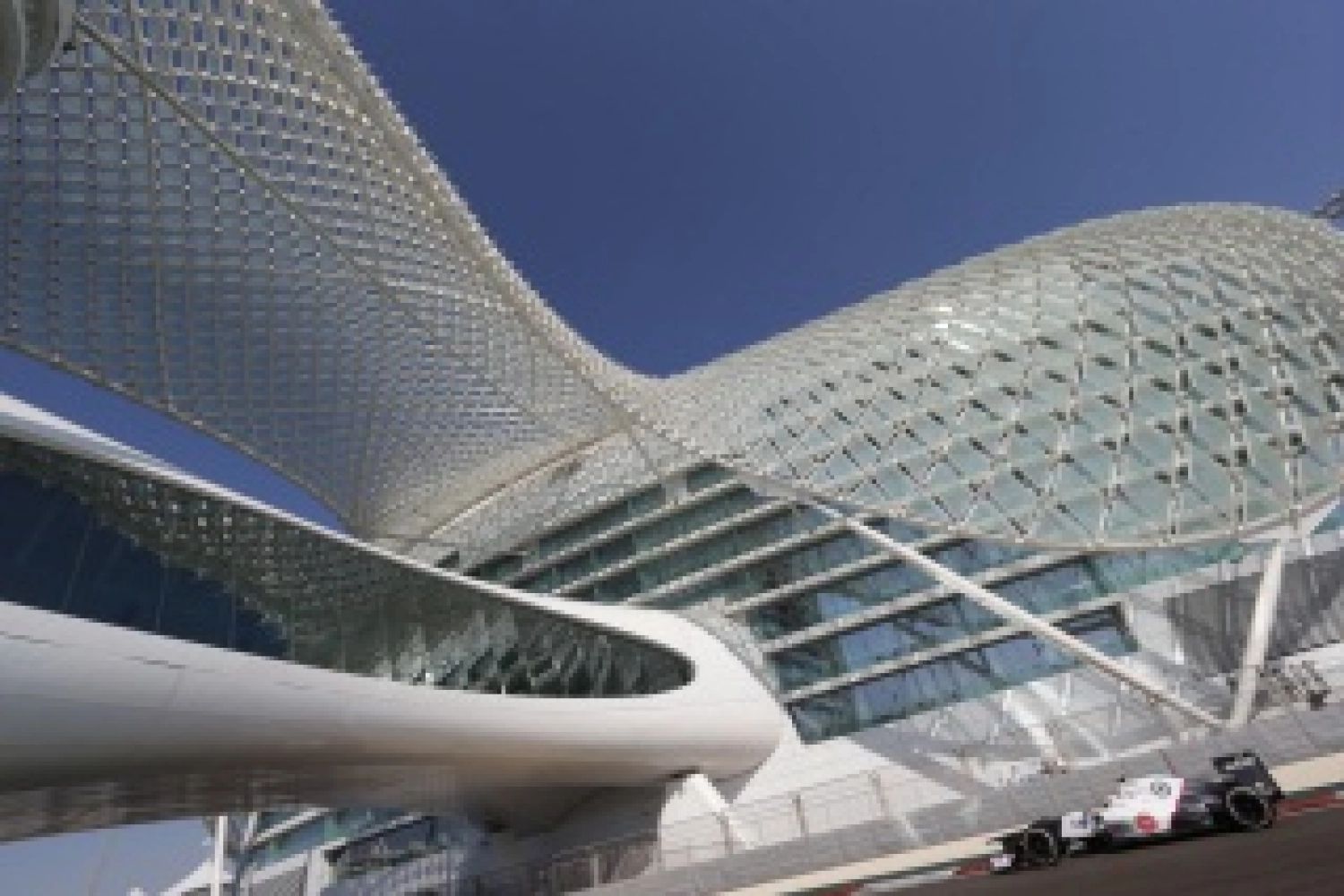
Less than a week after the Indian Grand Prix, which saw Sebastian Vettel clinch his 4th consecutive world championship title, Formula 1 is already back in business in Abu Dhabi.
The Abu Dhabi Grand Prix was the first twilight Grand Prix, and while this is complicated for the drivers, especially in terms of visibility, it is also challenging for the tires, with track temperatures dropping from 45°C at the start to 30°C at the finish when usually the track temperature increases throughout the race.
With two long straights, overtaking is possible in Abu Dhabi, but qualifying well helps in the pursuit of victory – last year, Kimi Räikkönen won ahead of the only driver to have won after qualifying beyond the front row. However, securing pole position is not a guarantee of victory, as in the four editions held, three pole-sitters didn’t see the checkered flag – Hamilton in 2009 due to a brake problem and in 2012 following a fuel pressure issue, and Vettel in 2011 after a puncture on the first corner.
The victory of the Finn last year, the first since his return, came 1163 days after his last one, in Belgium in 2009, but it remains far from the record in this regard held by Riccardo Patrese, who took 2403 days between two of his victories, in South Africa in 1983 and San Marino in 1990.
On the FIA’s side, Martin Donnelly has been appointed as the driver steward for this Abu Dhabi Grand Prix, which will offer drivers 2 DRS zones located on the two straights, with 2 detection points.
Yas Marina chassis side
Tom McCullough, Head of Track Engineering for the Sauber F1 Team:
« The Yas Marina circuit has three very different sectors. The first is short with corners taken at medium and high speeds, the middle sector is dominated by long straights with slow and tight corners, while the final sector is a series of slow and medium corners. The nature of the circuit makes it tough on the brakes and rear tires. As in New Delhi, Pirelli will supply the mediums and softs. The main objective of Friday’s free practice will be to understand how these tires perform on a very different track. »
Yas Marina engine side
Rémi Taffin, Track Operations Director of Renault Sport F1:
Yas Marina is one of those circuits that require neutral settings. There are long straights, but also slow and tight corners. Therefore, the engine must perform well under all circumstances rather than favoring a particular setting.
External factors to the track require special attention. As in India, the concentration of dust and sand in the atmosphere means that we must monitor the air filters to prevent them from clogging. This is particularly important given the ambient temperature. During the day, it can exceed 30°C. If the intake air is reduced by a small fraction, it can have detrimental effects on engine cooling.
It is also necessary to consider fuel consumption, which is one of the highest of the year. The nature of the track is demanding in this area, particularly in the last sector with this succession of ‘on-off’ segments. Consumption is also increased by the fact that we are at sea level. However, the most significant variation comes from the temperature change from one session to another. During the day, consumption is lower. At night, it increases. This nuance will be taken into account for the race to avoid finishing with too much or too little fuel.
Beyond these various challenges, we look forward to this Grand Prix. Although the Drivers’ and Constructors’ championships are awarded, the competition is open for the runner-up spots. We would like to enable Lotus to secure second place on both fronts. For Williams and Caterham, there are still three opportunities to score points. To achieve this, we must stay focused and keep pushing until Brazil.
Yas Marina tires side
The tires available for the drivers in Abu Dhabi are as follows:
– Soft (yellow sidewalls);
– Hard (orange sidewalls);
– Intermediate (green sidewalls);
– Rain (blue sidewalls).
Opinion of Paul Hembery, director of Pirelli Motorsport:
The way the temperature drops in Abu Dhabi naturally affects wear and degradation, meaning teams will be able to complete longer stints with the softest compound during the race. This has a significant impact on strategy: it’s often possible to try something different in Abu Dhabi compared to other locations, which can pay off at the end of the race. Abu Dhabi is a circuit we know very well because it’s where we did testing before entering Formula 1. It’s also where Formula 1 teams tried our tires for the first time at the end of the 2010 season.
Regarding the event, Yas Marina is the most modern and spectacular circuit of the year, with numerous technical challenges testing most of the global parameters of tire performance. Wear and degradation are not particularly high here: last year, when we also chose the medium and the soft compounds, most drivers only stopped once. As the compounds are generally softer this season, we expect two stops this time, although it is possible to see some teams attempting only one.
We will have to wait until Friday’s practice sessions to get a clearer idea of the lap time difference between the two compounds, but overall, we expect the pace to be quite tight at the front of the race. It is always in these circumstances that having the right strategy can really make a big difference. Although the level of track evolution is high and the test conditions are not always representative of those in the race, the work done on Friday and Saturday will be key to putting in place the most advantageous strategies possible for Sunday within the teams.
Jean Alesi’s opinion, Pirelli ambassador:
« Abu Dhabi is not a track on which I have raced, so it is difficult to comment on it from a driving perspective. But it is clearly spectacular to see, and it’s fantastic to see so much investment in infrastructure for F1. The only negative impression I initially had about the circuit was that it seemed quite difficult to overtake sometimes, but I think that issue is now resolved.
It is also interesting to see at the moment how much drivers use strategy to gain positions on the track. I am sure that pit stops will still be important this weekend in Abu Dhabi. This does not seem to be a particularly hard race for the tires, but the circumstances are a bit different from usual, with the race starting in the late afternoon. Therefore, it is difficult to predict what will happen.
There were times when I piloted at dusk and at night in Le Mans, and it’s really not easy. But I think it’s more straightforward in an F1 than in an endurance car because F1 cars don’t have headlights. Headlights make judging perspectives more difficult, especially when being overtaken, and it’s better to just have the track lighting, like in Singapore and Abu Dhabi.
Yas Marina in numbers
| Length of Yas Marina Circuit | 5.554 km |
| Number of turns | 21 (9 right and 12 left) |
| Average speed | 188 km/h |
| Top speed | 312 km/h |
| % of a lap at full load | 58 |
| Fuel consumption | 2.5 liters per lap; 64 l/100km |
| Lap record | 1:40.279 (Sebastian Vettel, Red Bull Racing, 2009) |
The Abu Dhabi Grand Prix 2012
Pole position.
Lewis Hamilton (McLaren) in 1:40.630
Podium:
1 – Kimi Räikkönen (Lotus F1 Team)
2 – Fernando Alonso (Ferrari)
3 – Sebastian Vettel (Red Bull Racing)
Fastest lap in the race:
Sebastian Vettel (Red Bull Racing) in 1:43.964
[i][From the press releases issued by the FIA, Pirelli, Renault Sport F1, and Sauber F1][/i]