Cyril Abiteboul explains his vision for Caterham
Cyril Abiteboul welcomed us in the Monza paddock to explain how he manages Caterham, from the upcoming engine regulation changes to his driver duo for 2014, including the business strategy implemented.

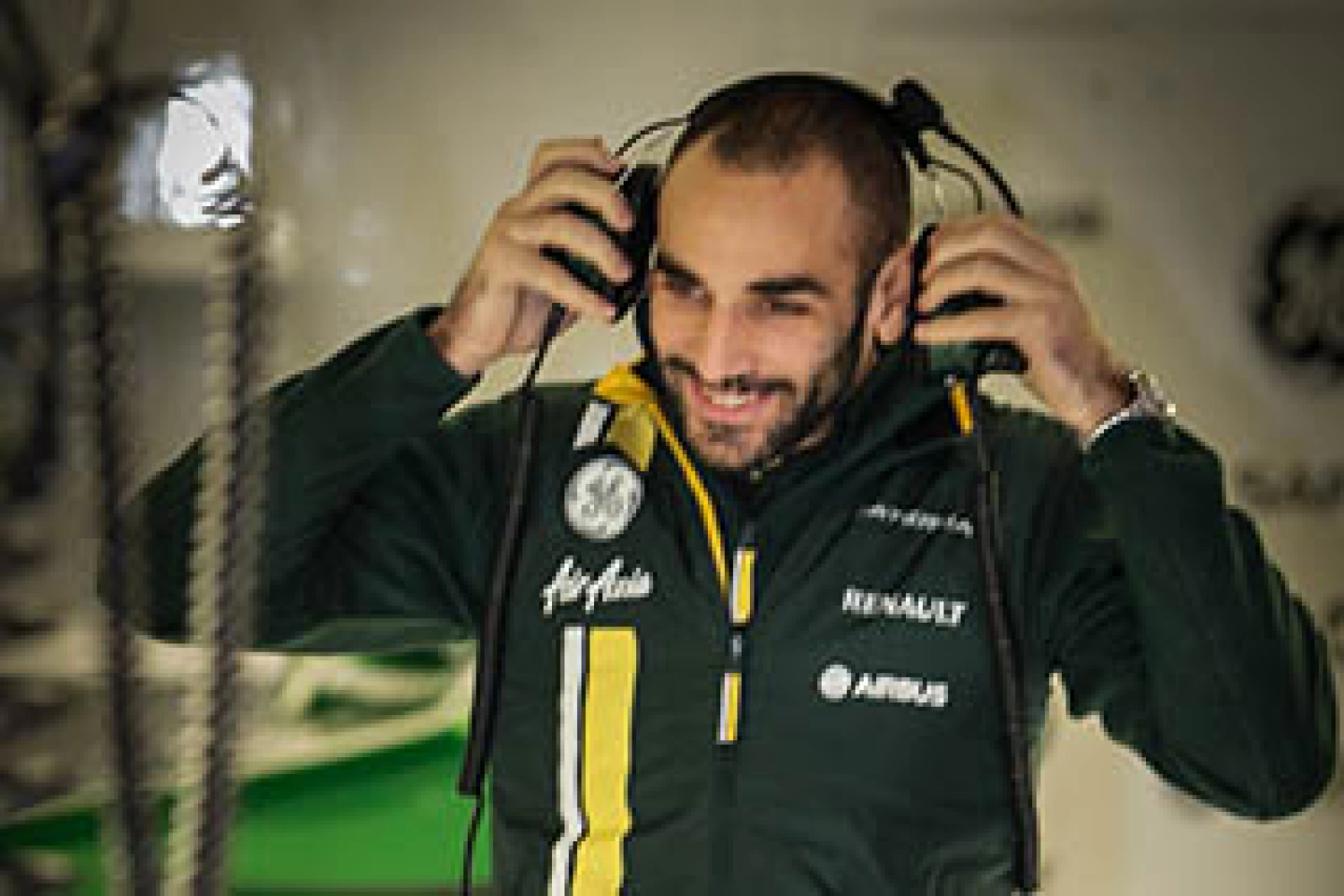
Here we are in Monza, a Grand Prix often used to make announcements for the future. Yet, as of today, it has still not been made official that Caterham will continue to be powered by Renault next season. Where do your discussions stand with your former employer?
No, it’s true, there hasn’t been any official announcement yet, but it won’t be a surprise to anyone when we announce something with Renault, of course. Because what connects us with Renault, beyond a Formula 1 engine, is an industrial project. The Caterham group has taken a stake in a joint venture with Renault. So it’s something that unites us in a very, very long-term way. While F1 engine contracts are usually about a year or two, here we are working on a car that is set to be released in early 2016.
Our main goal at Carterham is to connect production cars as much as possible with racing and, primarily, Formula 1. Therefore, it is evident that we must have the same engine supplier in tomorrow’s production cars as in Formula 1.
It was known that Carlos Tavares was a big fan of motorsports and one of the main internal supporters of the Alpine project, which was set up in a joint venture with Caterham. How might his departure from Renault impact Caterham Group?
« We should ask Renault but I don’t think so. We have contracts that are independent of individuals and even organizational changes, such as organizational charts. It happens everywhere. It’s true that Tavares had a natural enthusiasm for motorsport and sports products as well. He certainly helped accelerate the launch of the project because it’s very complicated for a mainstream manufacturer to venture into a more complex area like a small niche sports car. He did it with all his passion, enthusiasm, but also with all his professionalism. This means that all the economic criteria were right. Therefore, there is no reason for the project to be questioned. »
At the Friday press conference, Christian Horner acknowledged that the teams only had themselves to blame for agreeing to switch to the V6, which will be more expensive than the current V8. What is the impact for you?
Technological transitions are expensive, whether it’s the engine or evolving regulations. Formula 1 is a business of iteration: when regulations change little, the car changes little. Parts can be reused from one year to the next. We might not be the best example, but this year, nearly 50% of our car’s parts were carried over from last year. Next year, it will be around 1%. This means the car’s design must be completely revisited. So yes, the engine will not be cheaper. Beyond the engine, the entire car must be rebuilt. But anyway, I think sometimes technological transitions are necessary. It’s been a while since there have been major, major changes in Formula 1. So if Formula 1 wants to maintain its brand identity of innovation, it was important that this happened. It will hurt a bit, and then there will be a new period of stability where costs will decrease again. We must also live with the times.
What are the main differences you see between the operations of an engine manufacturer like Renault Sport F1 and a team like Caterham, after having experienced a top team with the Renault F1 Team?
« Everything is more limited, everything is more constrained and therefore more complicated. Not only financial resources but also human resources. The ability to conduct different projects in parallel and then the value of things. In a small company like ours, which is owned by private individuals, their money beyond our sponsors is their personal money. When you have a bit of intellectual honesty, you don’t manage budgets with the same sensitivity. In a large, multinational group with 150,000 people, budgets, even if they are well managed, remain just budgets. Here, we’re managing money, truly. I think what strikes me is that we become aware of the value of things. For example, a first-class ticket that can cost several thousand euros could represent the cost of manufacturing a front wing. We start connecting things we weren’t aware of before. In a sense, it’s very healthy, and I think many people should start doing this ».
In 2013, you chose to start the season with the 2012 car, before ramping up during the season with the introduction of the 2013 car. This strategy won’t be possible next year due to the significant regulatory change regarding the engine block. However, you are currently eleventh in the constructors’ championship, which places you outside the valuable top 10. Does this push you to continue developing the 2013 car longer than you would ideally like?
« No, we remained quite solid with respect to the strategy that was developed at the end of last year. The decision to start with the 2012 car is a decision I was not involved in since I joined the team much later. There is a trend in Formula 1 to do race-by-race management. On Monday morning after a bad Grand Prix or even after a good Grand Prix, plans can be reviewed. Obviously, one must be reactive. It’s impossible not to react to what happens. But it’s also important to have some strong guidelines and support them, especially when resources are limited. Therefore, we have to decide how to allocate them throughout the year. We cannot afford to continually go back and forth.
We made very, very few modifications to the plans we set for ourselves last winter, in which I was somewhat involved. The focus was on two major developments during the year. That’s what we did. I think that wasn’t a bad thing. To be very honest, the decision to keep the 2012 car at the beginning of the season is something that could cost us dearly in terms of the championship. Championships are often decided at the beginning of the season. Typically, this is true for those who win the championship but also for those who lose it. So it’s true that it could cost us a lot. What happened last year is that the car was pushed so hard at the end of 2012 that the beginning of 2013 suffered as a result.
How does this affect your factory’s workload plan concerning development?
« We are 95% dedicated to 2014. Our aero department is entirely focused on it, and a large part of our design office is dedicated to it. We’ve even started producing the first molds for the parts that we need to finalize as soon as possible because they take longer to manufacture. So we are making progress, but it’s complicated because we are not running projects in parallel. We might have started a little later than some, and paradoxically, we need to finalize things a bit earlier than others. So we are constrained both at the beginning and end of the cycle. As a result, we find ourselves with a relatively short development phase. It’s the case for other teams as well.
But next year, it’s a monster of engineering. It’s something exciting. I really want to be at the first race next year. It’s going to be really fun to watch.
We were just talking about it yesterday with Paul Hembery from Pirelli, who has started to receive data from the teams and there isn’t a clear direction emerging among them, which will renew interest in the sport in general.
« It’s going to be a real mess, between those who won’t finish, those who will be three seconds per lap but especially won’t finish in my opinion. »
Oksana Kossatchenko was hired at the beginning of the year as the head of commercial acquisitions, specifically to attract new sponsors and partners. At the end of July, we heard that she might have left the company. Can you tell us more about this?
No, because there is not much to say on the subject. To establish the facts, Oksana held a position she can no longer hold today, but she remains, of course, within the Caterham family. We are on very good terms, she was here yesterday (Saturday). She continues to work on a number of subjects for us. There are personnel movements in all teams. Many other people have moved, some to more key positions. There is a new head of aero. There will soon be a new assistant technical director appointed. This is more important.
Many of the team’s partners are companies owned by Tony Fernandes (EQ8, Air Asia…), the team’s shareholder, or some of his business connections (Airbus…). Is this a commercial strategy intended to last, or do you wish to expand your network of sponsors and partners?
I would be very happy if these companies that are present find enough value in what we do to stay in F1. For two of these companies, Airbus and GE, which are two magnificent companies, it’s their first experience in F1. So I hope that what we offer them suits them. It’s something we will necessarily have to evolve, find other companies. The idea is through these companies that have access to many other companies, to network with new people in order to try to acquire new companies. But it’s not easy when you’re a team like where we are.
So what we’re trying to highlight is our reasonable plans for the future. Our stability as well. Our industrial project is something that brings us a lot of value because it provides stability. It’s our added value because we need to be there in 2016 to market a car that will be released at that time. We will need to be more competitive in 2016. It gives us a certain form of luxury to project into the future. For example, I have nothing against Sauber, which is a very fine team, but if Sauber stops, there is no associated industrial project. I certainly wish them well, but they are racing for the sake of racing. We are here for a marketing purpose, which reassures sponsors as well as employees. To be honest, employees have questions, they are worried. All employees in Formula 1 are worried. We regularly read things about others whom I would not mention. We don’t have those kinds of problems. Formula 1 is an industry under very strong economic pressure. The prospect of an industrial project is reassuring.
You find something there that is similar to what you experienced at Renault.
Exactly the same with a connection that is more direct because we sell cars, certainly a bit old, a bit outdated, but being in a Caterham, it’s the closest sensation I know to a single-seater. The car is a bit old but it’s completely connected to Formula 1. Personally, I find that we’re closer to F1 in a Caterham than in a Ferrari Scuderia, which is magnificent but has nothing to do with it.
For the 2013 season, you chose to move from a duo of experienced drivers (Heikki Kovalaien and Vitaly Petrov) to a very young duo (Charles Pic and Giedo van der Garde). However, you decided to call back Heikki Kovalainen during the season for testing. Did you feel that you went too far with the youthfulness of your drivers?
« Not yet. I will take stock at the end of the season. It’s a bit early to draw conclusions. Today our two drivers are making progress, maybe at different rates and according to a different pattern. Charles has more experience. He is making progress. We are also making progress. We are two young entities. The team is young, the two drivers are young. We must ensure that one doesn’t hold back the other. I don’t have that certainty today that someone is preventing the other from growing. »
When do you plan to make an announcement about your driver duo for 2014?
« The decision hasn’t been made yet, but I would like to make it fairly quickly. There are so many things to do this winter that I would like, if there are new people, which is not excluded, to work as soon as possible this winter. There will be so many things to manage that people will have to know each other perfectly. We saw that it took almost half the season for the team to understand how the drivers operate. We’re still learning on a human level. It’s something I would like to avoid at the beginning of the season next year. »
When I met Alexander Rossi at Silverstone, he told me he wanted to follow in the footsteps of Giedo van der Garde, who spent a year as a reserve driver and in GP2 with you before being promoted to a regular seat. Is this something you are considering for him next season?
« It’s something conceivable, it’s something I wish for him, but he has to prove himself. »
Last year, you decided to relocate your headquarters. Do you feel that this change has given you an advantage this season?
« This clearly took something away from us in preparing this year. For two, three months, engineering and production were at a standstill. It’s also one of the reasons we didn’t have the new car at the start of the year. So in a way, it cost us something this year. But I have no doubt it will bring us something in the future. It has already started to bring us something. We are already much more economically efficient. When we produce a part, we can do it in-house whereas before, a large part of the car was outsourced. Now we produce three times more in value than we did before. These are savings or performance improvements in the long term. »
What do you think you still lack to compete with the teams ahead of you?
« Aero, aero, aero, and more aero. The engine is one that wins races, including at Monza. It hasn’t won yet but it’s on pole position, even though it’s said to be lacking in power. I think between Spa and Monza, things have been set straight. We have an excellent engine, we have the same tires as everyone else, we have drivers who are performing well, we have Total fuel, we have the KERS from Red Bull Renault, we have the Renault gearbox. So if you take all that away, it’s a bit of mechanical design and a lot of aero. But we know that, we’re working on it. We’re trying to have the right target for next year. »
Do you think that the close ties you have with Renault will allow you to offset part of this deficit next year?
« Typically, today, the engine doesn’t allow for compensation of the aero deficit. We’ll have to see if that can be reversed, if a motor deficit can be compensated by aero. »
From our special correspondent in Monza