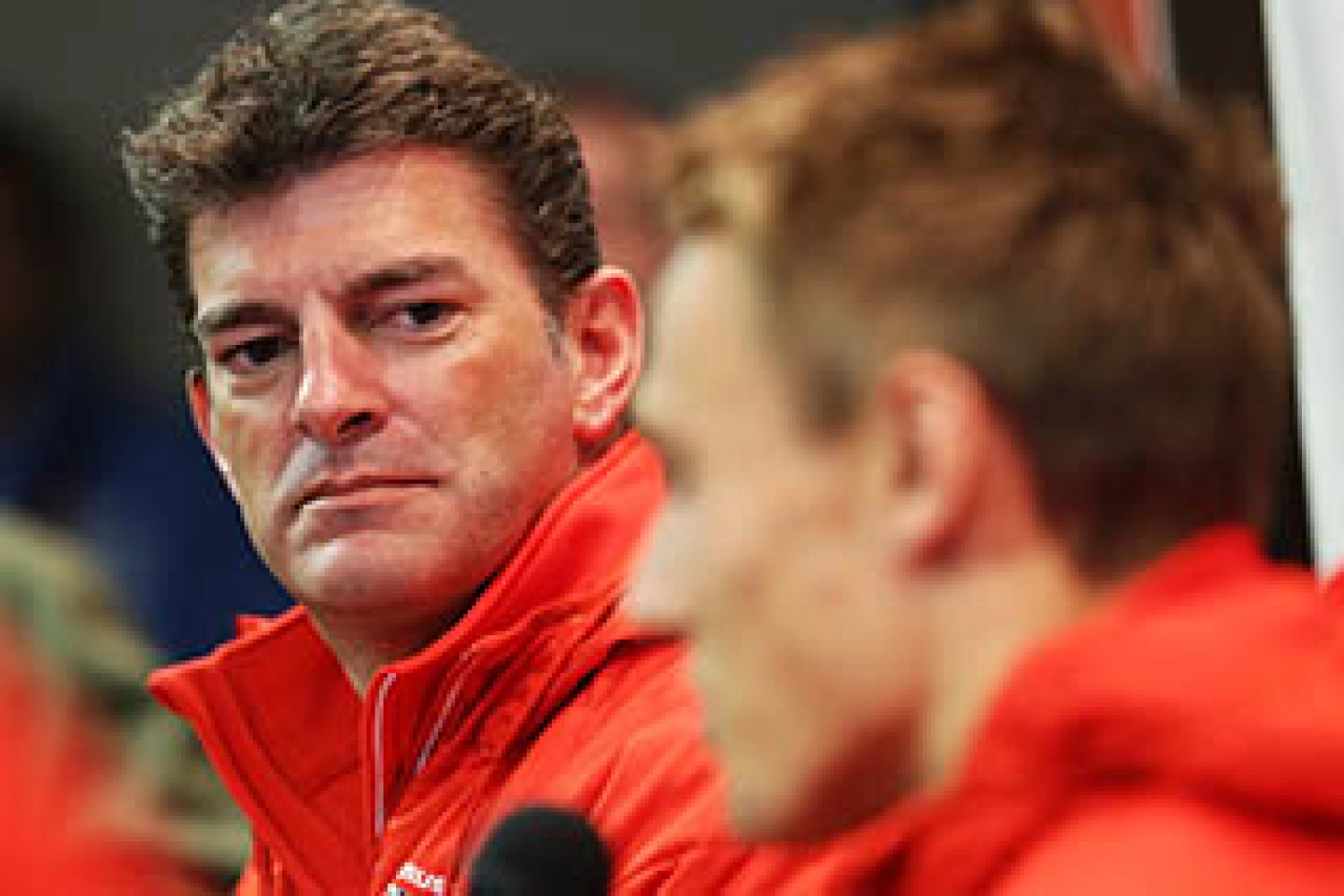
Graeme Lowdon, the president of Marussia F1, welcomes us to Monza
Graeme Lowdon, the president of the F1 team Marussia, opened the doors of his motorhome to discuss all the hot topics concerning his team and F1 in general: the 2014 drivers, the engine change, the RRA, and development paths for the future.

How do you judge your season: you started very well by dominating Caterham. But since then, they seem to have overtaken you. How do you explain that?
You are right, we started the season very well in the first races outside Europe. Upon returning to Europe, Caterham made a lot of progress with many improvements. In the last races, I think they had a faster car than ours. However, we had some great races and great qualifying sessions. The drivers did a good job. F1 is very competitive, and what matters is the world championship standings, and we are still ahead of Caterham in the [constructors’] championship.
We had a good day yesterday [with Friday’s free practice]. So we can hope that we’ve regained a bit more speed and that we’ll keep it today in qualifying. There’s competition everywhere in Formula 1, not just at the top of the grid. We know from last year that we have to fight until the last lap of the last race [Editor’s note: Marussia lost its 10th place in the Constructors’ Championship with 5 laps to go in the final race in Brazil when Vitaly Petrov finished 11th for Caterham]. That’s what we’re going to do this year.
The 2014 season will bring many technical changes, especially around the engine block. What is the current distribution of work at the factory between the 2013 car and the 2014 car?
« We are almost 100% focused on 2014 now. This has been the case for quite some time now. Compared to the bigger teams, we have much more limited engineering resources. So it’s an even more important decision for us to know which program we focus on.
The 2014 program is on schedule, the car looks good. Our working relationship with our engine supplier, Ferrari, is working very, very well. We are therefore confident of having a good package for 2014. So our engineering and manufacturing teams are focused on that while our racing team is concentrating on the rest of the 2013 season.
We have been hearing for several months that next year’s V6 will be significantly more expensive than this year’s V8. What financial impact will the arrival of this new V6 engine have for you compared to the current V8 and the switch from Cosworth to Ferrari?
We had a four-year relationship with Cosworth, which was fantastic. They have been very good partners. That’s why we stayed with them for so long because it worked very well for us. We have established great friendships there. But Cosworth decided not to produce a 2014 engine. So the decision to change was easy for us.
Everything is going very well since we started working with Ferrari. They really have very good engineers. The communication between us is excellent. We therefore hope to benefit from a new long-term partnership for our engine with Ferrari.
We know that one of your current drivers is part of the Ferrari Driver Academy. Does now having a Ferrari engine mean that Jules Bianchi will stay with you next year?
« No, no! The discussions for the engine are completely separate from the rest. I think where it helped us is that since Jules is a driver from the Ferrari Driver Academy, Ferrari followed his progress and our progress much more closely than they would have otherwise. You have to believe them and believe Jules when they say they were pleasantly surprised when they saw that we were evolving as a professional team. I think this influenced their decision to collaborate with us, hopefully in the long term. The connection with Jules allowed them to get to know us better. They now have an insider’s knowledge. They were able to see how we work. »
Does being powered by Ferrari give you extra leverage in your discussions with Bernie Ecclestone, with whom you are the only team without a current commercial agreement?
Uh, you know, we believe our position on the commercial aspect is fair and equitable. We don’t need additional support. We are making progress in these discussions and we will continue until we find an agreement. That being said, it’s always better to have more friends than fewer in the paddock. For our commercial agreement, I think we are on the right track.
Does the absence of this agreement threaten your economic model, or even the very existence of your team, or can you live without it?
« There is a lot of competition in F1, but like everywhere, you need stability. You need to have the opportunity to plan things. Where this has already hurt us as a team is that, unlike other teams that received additional money, we received less than we expected.
This will necessarily have an impact on our technical program because if you have more money, you can make your car faster. If your car goes faster, you can rank higher in the championship. If you finish higher in the championship, you can receive more money. It becomes a cycle. So if you break this cycle, as has happened, it harms the team. It is our role in management to ensure that the company is protected and can move forward. It’s certain that it’s not a good thing not to receive the money you expected to receive.
What are the main differences you see between the functioning of an F1 team and that of a normal business, like the ones you’ve founded and managed in the past?
« You have the same pressure. Management has the same pressure as what I had seen in my previous experiences. One of the main differences is the commercial landscape. There is only one holder of commercial rights, who is in a dominant position. This exists in many other industries, but there are also many industries where the market is completely free. We employ people, we have established a strategy that we follow. We have problems that might seem similar to those that managers encounter in other industries.
So yes, Formula 1 is a sport but it’s also a business. You could even say it’s too much of a business to be a sport, but you could also say it’s too much of a sport to be a business. But F1 is very expensive. There are risks that these costs could become too high. It’s important to have a structure where success is linked to skills and not just finances.
On your website, you have a section dedicated to merchandise under your name. Is this an area you want to expand in the coming years, particularly with mainstream brands as partners? Are you looking at what is being done in other sports, like Nascar, where merchandising represents a significant source of revenue for the teams?
This does not represent a very significant part of our income, but it’s not negligible either. There is demand, we have received many requests. We have strong support. Our fan base is very active. They love our merchandising, especially since it’s really cool this year. Like any business, when you see that there is demand, you seek to satisfy it.
For Formula 1 in general, not just for us as a team, there is a good growth opportunity through merchandising. For other sports, it represents a larger percentage of their revenue. It’s an opportunity.
Is this aspect part of the agreement you made with the Reading Football Club, which you announced at Silverstone?
« Yes, our agreement is broad. It allows for this kind of discussion. I think we can learn a lot from other sports, not just football. I also think they can learn a lot from how we work in Formula 1. We have many topics to discuss with them. The structure of professional football is different from what we have in Formula 1 in terms of the economic model, but there are common topics. It is always good to have discussions with the outside. »
From a more general point of view, many of the team’s partners (A-Qas, Bifold, ATG Access) are companies owned by your former co-owner LDC. Is this a business strategy that is intended to continue, or do you wish to expand your network of sponsors and partners?
« This allowed LDC to see the business opportunities that exist in F1. It gave us the chance to sell our image, to make our brand known to the companies we were in contact with. It went very well. Many companies are currently looking to renew their agreements. It has thus been a very fruitful relationship. The CEO of LDC is still a non-executive director on our board. We have therefore maintained very good relations with them. We are hosting many of their guests this weekend in Monza. »
The sale of the shares held by LDC was more desired by LDC, which wanted to disengage, or was it Marussia’s intention to own 100% of its team?
« Both. LDC is an investment fund. Their job is to help finance companies through growth. So it’s not unusual for them to resell businesses, that’s what they do. As with any transaction, there must be one party willing to sell and the other willing to buy. This happened at the right time, and we reached an agreement quite quickly. »
For the 2013 season, you chose to do without an experienced driver (Timo Glock) and have a very young duo. When do you plan to make an announcement about your driver duo for 2014?
Our duo of drivers this year worked very well. In the past, we had always wanted to have a young driver alongside a very experienced driver. As a team, we have always wanted to bring in young drivers. That’s why we have a team in GP3. We are always looking to promote new talent. This year, we made the decision to bring in two less experienced drivers, but I think it worked very well. There is a very good relationship between the two drivers. They push each other. They both did a very good job.
For the next season, as you know, there are always discussions in F1. We are looking at the opportunities that may arise. Generally, we make our announcements around mid-December. There are no particular reasons for this, but it’s what we usually do. However, last year, we made our contract with Jules much later than that. So we will see when we make our announcement.
Russia is set to join the calendar in 2014. Would it be important for you as an Anglo-Russian team to have a Russian driver in your line-up?
« As you say, we are an Anglo-Russian team. We have a license from the Russian federation. We always look at what is the best combination for the team. So if it’s a Russian driver who is extremely fast, that’s perfect. But above all, we need an extremely fast driver. Therefore, we look at the driver market, drivers racing in GP2, GP3, or even lower. We are an Anglo-Russian team, but we primarily aim to have the best possible pair of drivers. »
What do you think you still lack to compete with the teams ahead of you?
« With the current technical regulations, I think there are still too many opportunities to buy success with money instead of earning it through skills. It’s really a shame given the commercial structure we have. If we had a share of the commercial revenues, our car would definitely be faster. It’s as simple as that. But we have to live with the commercial reality of F1 as it is currently. We have to work harder, smarter. It is widely known that we have the smallest budget in the paddock and yet we are not last in the championship. So we must keep working the way we currently do and see where we are at the end of the season. »
Yesterday at the FIA’s Friday press conference, there were discussions about the RRA. Is it essential for you?
« Yes, absolutely. When our entry was accepted in June 2009, we were three new teams that had been accepted. Today, we are the only ones still here, which is really unfortunate. I am convinced that the reason is because we entered with a commercial and technical structure that allowed for balancing things to enable a new team to compete. There was a maximum spending cap with technical advantages if you accepted this cap.
It has been replaced by the RRA. The idea was that it would limit spending to the levels seen in F1 at the beginning of the 1990s. From my perspective, that never happened. The limit is much higher. I regret it. I think it’s a bad thing for the sport and it’s a bad thing for the teams that came with good faith based on this.
The RRA is very important. It’s a shame that some teams have interpreted the RRA to allow them to spend more. People have forgotten the initial objective. The initial objective was very clear and had been clearly explained to the teams. It was about returning to the level of spending from the 1990s. It’s really difficult to write very detailed financial and technical rules, but there was a gentlemen’s agreement, and it’s really a shame that other teams have decided to go in another direction.
From our special correspondent in Monza