Why are the other drivers helping Max Verstappen to climb 9 positions in 15 laps?
In Miami, we witnessed a remontada by Max Verstappen. Starting from the 9th position, the Dutch driver took the lead of the Grand Prix after 19 laps and never let it go, all without any spectacle on the track. We will explain why.

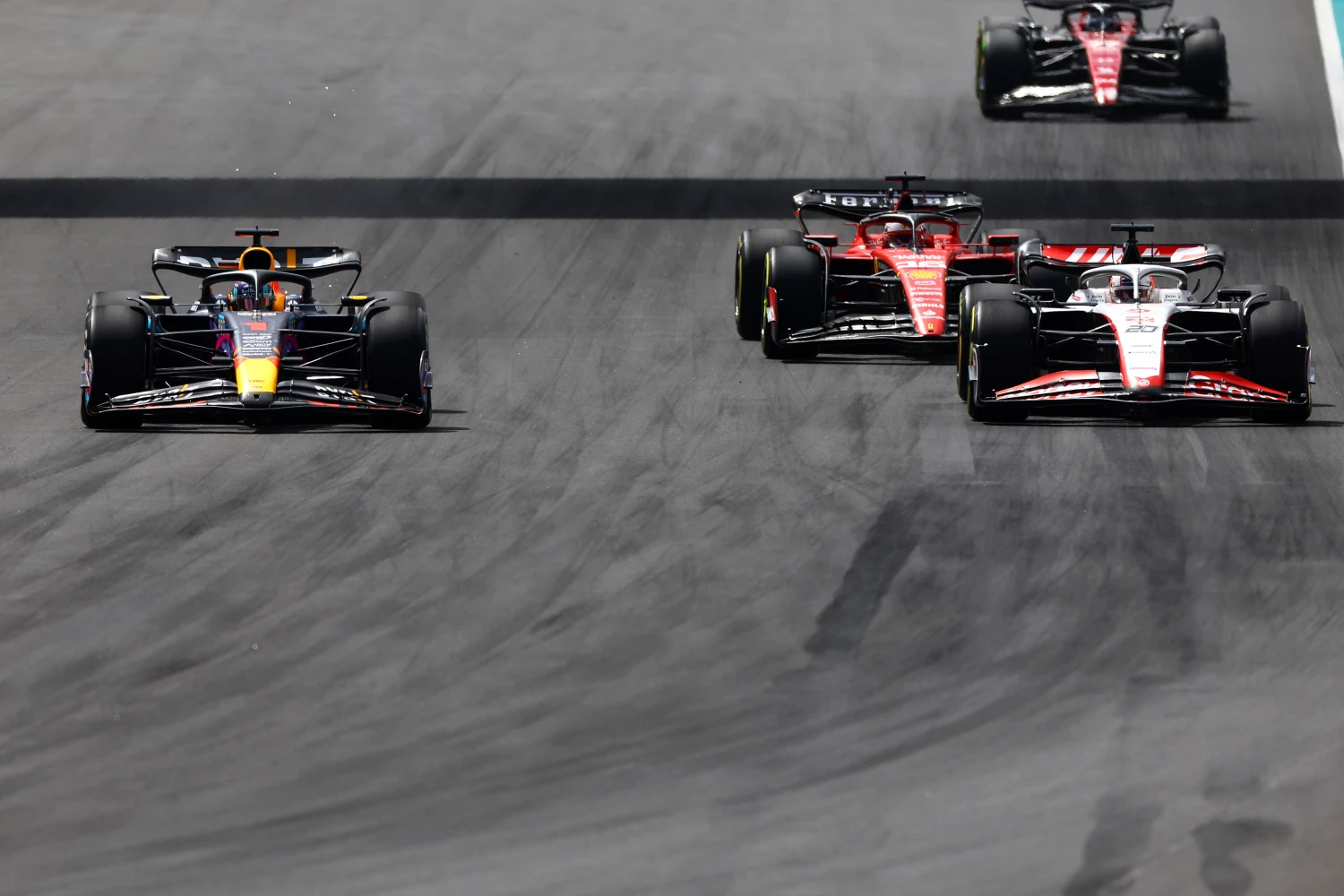
We are on the starting grid of the Miami Grand Prix. Max Verstappen, two-time Formula 1 World Champion, in a Red Bull, is positioned in 9th place. This position is unusual considering the performances of Red Bull at the beginning of the 2023 season. The Austrian team is crushing the competition and achieving double after double, thanks also to the performances of Sergio Perez, Max Verstappen’s teammate.
However, for Verstappen the day before, the qualifying did not go as he had hoped. Missing a sector during his first timed lap in Q3, he did not record any time, and then an accident stopped the qualifying session. As a result, he found himself in 9th place, while his teammate took advantage and secured pole position.
The comeback of Max Verstappen in 15 laps
At the start, cautious Max Verstappen maintains his position. He is then about 6 seconds behind his teammate, with each driver separated by a few tenths after the start. He will quickly begin to overtake, especially on the straights, thanks to a very high top speed. In the 2nd lap, he overtakes Valtteri Bottas in the Alfa Romeo and finds himself in 8th place.
In the third lap, Max Verstappen indulges in the luxury of overtaking two cars at once, at the same braking point. While he is slipstreaming the Haas of Magnussen, the Danish driver himself is in the process of overtaking, also using the slipstream, Charles Leclerc’s struggling Ferrari. Max Verstappen, seizing the opportunity, brakes alongside the Haas from the inside and overtakes both cars in the same straight, propelling himself to 6th place by the 4th lap.
The next contender is George Russell in the Mercedes. Although separated by a few seconds, the Red Bull manages to find such straight-line speed in less than 4 laps, accompanied by the DRS to take the advantage over the Mercedes without a struggle.
In lap 8, Max Verstappen, in 5th place, still maintains a gap of approximately 5 seconds with the race leader, Sergio Pérez, who is unable to pull away. He is constantly being followed by Fernando Alonso in the Aston Martin, staying within 2 seconds. Max Verstappen will overtake Pierre Gasly’s Alpine in lap 9, virtually putting him in pursuit of the drivers on the podium in just 9 laps.
Getting closer to Carlos Sainz’s Ferrari with half-second increments, he will catch the slipstream in lap 14 and, aided by the powerful DRS, overtake the Ferrari to take P3. Alonso is only a few tenths behind. It will only take one lap for the Dutchman to pass the Aston Martin and go after the race leader.
Sergio Perez will not be overtaken by his teammate in the race. The Mexican driver, who was leading, is struggling with his tires. He requests to pit on lap 19 and Verstappen takes over the lead, which he will not give up. In less than 20 laps, Verstappen has climbed up from P9 to the leading position, making 8 overtakes on track.
No driver has fought against Verstappen’s Red Bull
If every F1 driver fights for victory in Formula 1, it becomes very clear from this Grand Prix that battling for position makes no sense when the performance gap is too large. The facts are there. The drivers from P8 to P2 did not put up any resistance against Max Verstappen’s Red Bull.
Some found themselves caught by surprise, not expecting the Red Bull to be so fast on the straight. Others cleared the way for the Red Bull, almost moving aside as if they had a blue flag.
This attitude seems surprising for a spectator and appears contrary to the spirit of Formula 1. However, holding onto the 8th position at the start of the Grand Prix doesn’t make sense for the strategists of teams with less powerful race cars. Indeed, drivers establish strategies and must maintain a certain pace in order to avoid excessive tire degradation. Engaging in a battle against another driver raises the tire temperature and consequently accelerates rubber wear.
Fighting against a faster driver can therefore be highly counterproductive and could result in a substantial loss of points. This was the case that weekend in Miami, at the beginning of the Grand Prix, completely ruining the racing spectacle.
It is not for nothing today that tires are a big part of teams’ success. A team that manages to use tires in the best performance window of its car will give its driver the best chance to optimize their strategy, sometimes to the detriment of the show and battles on the track.
Fighting against a stronger race car still makes sense
In 2021 in Hungary, Alonso resisted Hamilton’s Mercedes for many laps, allowing his teammate, who was leading the Grand Prix at the time, to build up enough of a lead to secure the victory. Without this unequal battle, with Mercedes being stronger on paper, Alpine would not have won the race.
Fighting against a faster driver therefore makes sense in certain situations.
This type of situation occurs when the dice are rolled and the drivers alone can be the key to success. That wasn’t the case in Miami, in the first 20 laps.