Verstappen loses victory due to Bahrain differential
Max Verstappen took pole nearly four tenths of a second ahead of Lewis Hamilton at the Bahrain Grand Prix, but lost out to the Englishman on race day. Mercedes used a clever strategy to get Hamilton ahead of Verstappen, but the Red Bull driver also said that a differential problem cost him race pace and therefore probably victory.

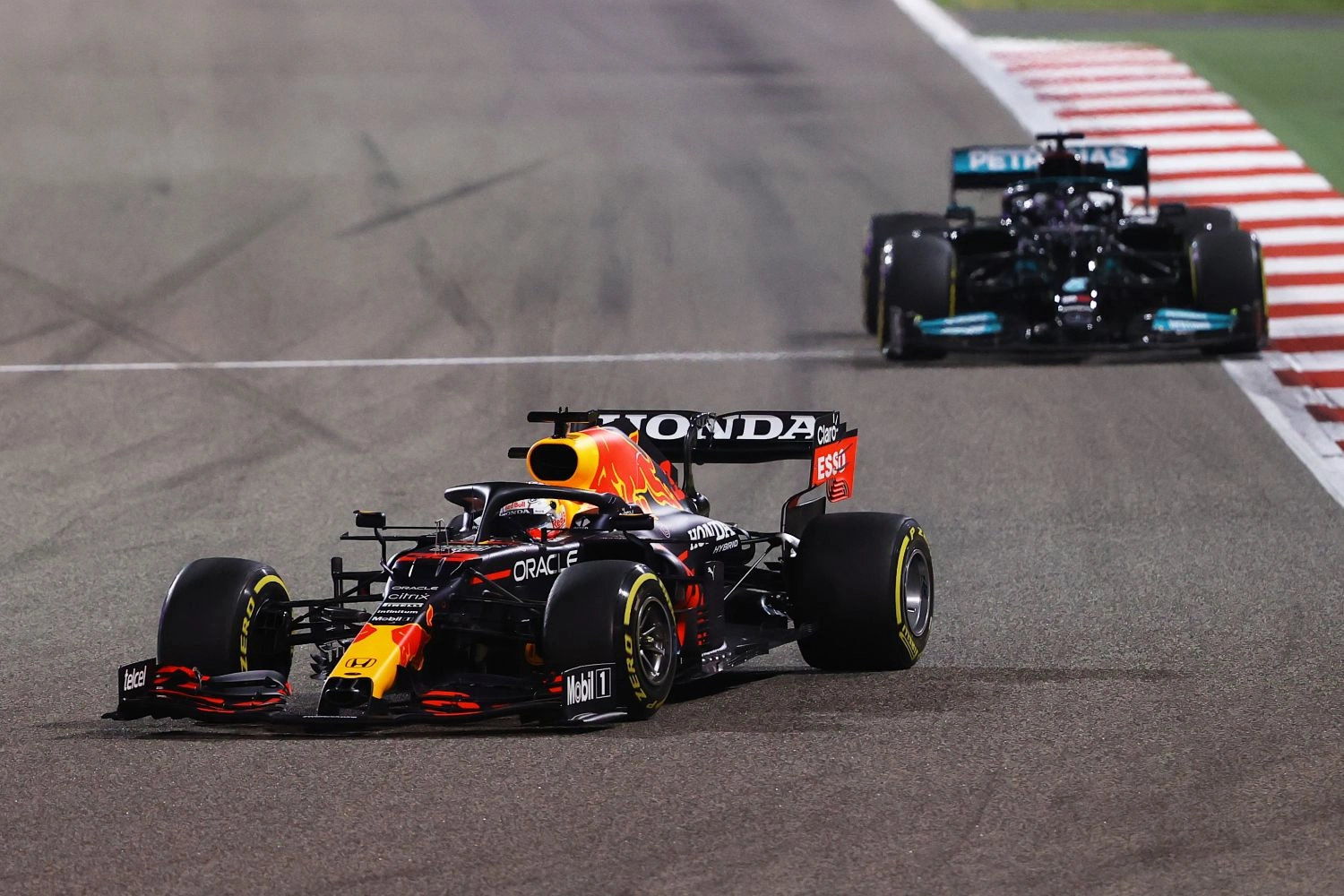
Max Verstappen’s differential problem during the Bahrain Grand Prix, which kicked off the season, was causing him to lose up to 0.3 seconds per lap in the first stint, according to Red Bull’s Helmut Marko. This prevented Verstappen from capitalizing on the pace advantage he had over Mercedes in qualifying to stay out of reach from Lewis Hamilton, ultimately being the reason why he lost the race.
This is not the only technical problem that Red Bull experienced during this race. Indeed, Sergio Perez’s car suffered a mechanical failure during the formation lap. An incident that forced him to enter the pit lane to reset his car. Initially positioned eleventh on the starting grid, he will then be forced to start from the pit lane.
The differential, what is it for?
The keen gaze of Mark Hughes explains that the differential is located in the gearbox between the rear wheels and determines the proportion of power that the inner and outer rear wheels receive (on a given turn). The inner wheel (on a left turn, the rear left) will need fewer turns than the outer wheel to make the same turn. The differential is the mechanism that distributes the appropriate power to each wheel, through interconnected gears.
But the differential can also be configured more aggressively, using friction to modify the torque distribution between each wheel to facilitate the rotation of the car or stabilize it during braking.
A completely “open” differential simply distributes power based on the angle of the turn. A fully locked differential allows no distribution, and the inner wheel, which receives more power than it needs, is forced to negotiate the turn by “scrubbing” on the surface, with the torque from the outer wheel actually helping to rotate the car.
There is an infinite range between these two points, completely open and completely locked. The use of an electro-hydraulic control for the differential in F1 allows varying the resistance between the adjustment points, via a switch on the steering wheel. This allows controlling the friction resistance by varying the hydraulic pressure on the friction plate.
A completely open differential provides equal torque to each wheel, regardless of their different speeds. The inner wheel will eventually slip, and the differential will then transfer torque to both wheels. This makes the car very smooth in how it delivers power in a turn, but with low traction limits and very gentle, easily controlled wheel slip.
This would give good control on a low-adhesion surface where there isn’t much traction force available anyway. But a more locked differential, by resisting the transmission of torque to the limiting inner wheel, will transmit more to the outer wheel and therefore provide more traction for acceleration. In doing so, it eases the car’s steering. But when traction breaks loose, it is more aggressive.
In general, the greater the grip, the more likely the driver is to use the differential lock. Thus, softer tires and a rubberized track will encourage the driver to use the differential lock more often to help change direction more quickly.
What has been the impact for Verstappen?
Verstappen noticed from the formation lap that the inside wheel was spinning at turns 1-2. He then reacted by selecting a higher locking degree on the differential. The display on the steering wheel confirmed his choice, but the car’s behavior remained unchanged. He had to adapt his driving accordingly, being less aggressive in applying power at the exit of these low-speed corners.
He lost time in the turn, but the skating of the inner wheel also increased the tire surface temperature.
On a circuit like Sakhir, which already induces high rates of thermal performance degradation, drivers must drive according to the temperature of their rear tires. They can’t just push flat out, as that would force them to pit very early and multiple times. As sliding increased tire temperatures, Verstappen had to drive the rest of the lap more conservatively than he otherwise would to prevent rear temperatures from spiraling out of control and constantly rising.
Therefore the reason why Hamilton, driving a Mercedes that couldn’t keep up with the Red Bull in qualifying, was able to stay close enough to be within reach for an undercut (the act of pitting earlier to benefit from a faster out lap than his competitor) when the first pit window opened.
The promise of an exciting season
Red Bull and Verstappen seem ready this year to deliver a fierce battle to Mercedes and Hamilton. However, the Austrian team must be flawless, especially in terms of reliability, to hope to have a chance in this duel. Whether it is for Verstappen’s car aiming for the world championship title or for that famous second Red Bull car which, despite having a series of talented drivers like Pierre Gasly or Alexander Albon, has never managed to keep its promises. We saw it again this weekend as Sergio Pérez had to start from the pit lane after a problem during his warm-up lap.