Exclusive tête-à-tête with Paul Hembery, Pirelli’s Director of Motorsport
MotorsInside takes advantage of its presence in the Monza paddock to meet those who make this sport what it is today. This is how we met Paul Hembery, Pirelli's competition director. No topic was left untouched.

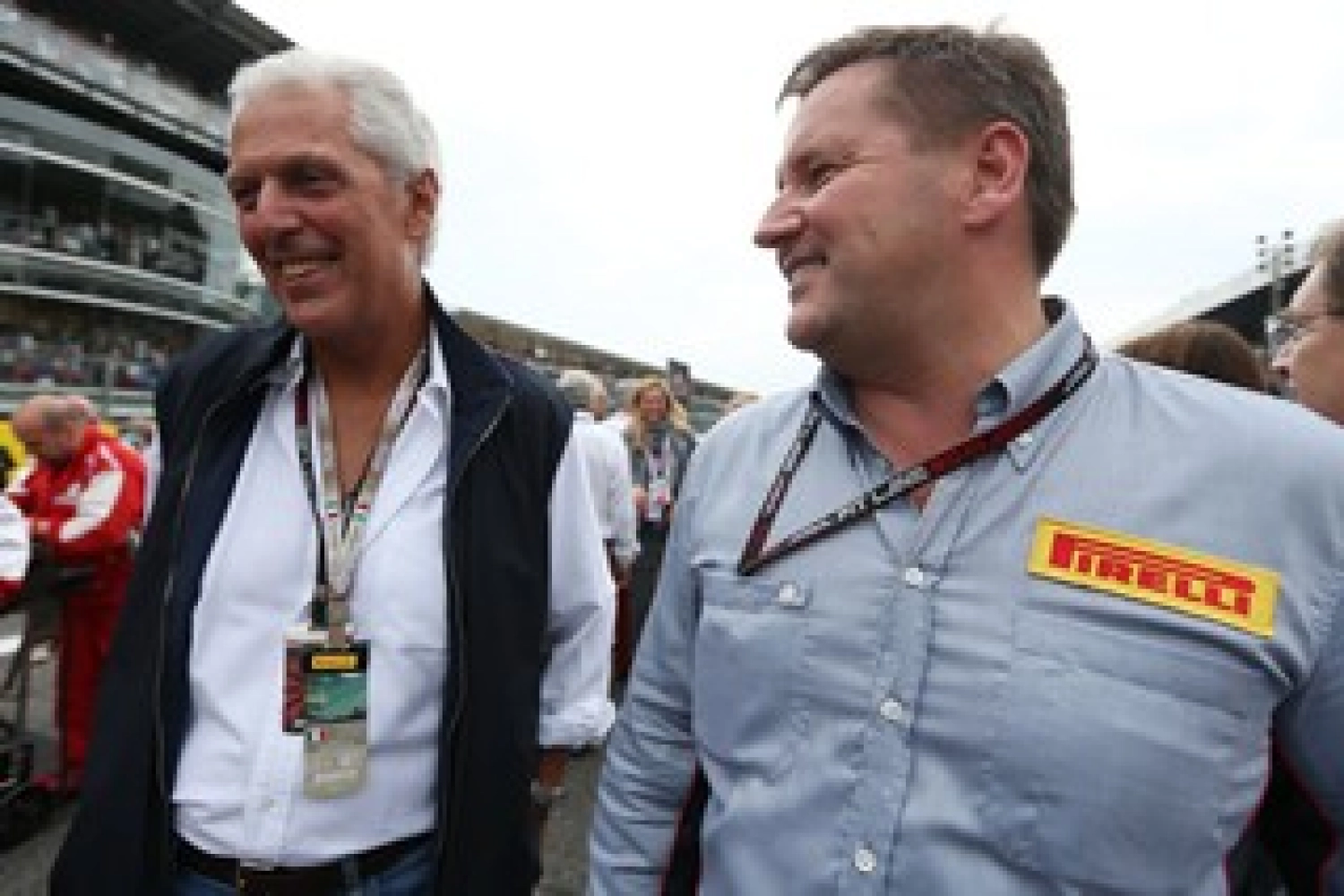
Here we are in Monza, the Grand Prix home to Pirelli, and you have not yet been officially confirmed as the tire supplier for F1 for the 2014 season and beyond. How do you explain this non-announcement?
« Well, there is no procedure. That’s the problem. We have an agreement with the promoter. We have an agreement with all the teams. So we hope we can settle the last details with the FIA. We believe we have done everything we needed to do in order to continue. »
It seems that the FIA must launch a call for tenders on the subject. However, for there to be a call for tenders, there must be several candidates. Are you afraid that one of your competitors might come forward?
« It’s a bit late to launch a call for tenders. A call for tenders should have been made last year. Not now, two weeks before providing the technical details to the teams. It’s unrealistic. We’ll have to ask them why they didn’t do it. We didn’t have a call for tenders the last time either. This is a matter mainly dealt with by the promoter. I know they’ve talked to many manufacturers, but most of them told them they weren’t interested. So in the end, he decided to work with us because there was no one else. »
Do you have a deadline for a definitive answer on next season? What is your board of directors’ position on the current situation?
« We have been working for next year for four months. The deadline was four months ago. Because, in the end, what do you want? For there to be no tires in sports next year? So we had to keep working. »
Would it be a problem for you if the FIA decided to abandon the single manufacturer status you have had since 2011 and decided to reintroduce competition in this sector starting from the next season?
« Yes because it would mean they would be in breach of our contract. We have a long-term contract in place. »
Let’s now evaluate your three years as the exclusive manufacturer in F1. What impact has your presence had in F1?
« We were asked to do something different for the sport to create more interesting races. This sport used to have about 300 overtakes per season. Now we are at 1200 – 1300. So it’s a significant increase. Obviously, it’s not just thanks to the tires but also thanks to the DRS and KERS, but that’s why the package was decided.
But for the future, that may change. Next year, there are big changes on the engines. Next year, we will talk a lot about the engines. From my point of view, this is a good thing. We all need to be interested in knowing what the next road car technologies will be. So it’s time for us to take a step back. So next year, you will be interviewing the engine manufacturers about their commitment to this sport.
We did what the sport wanted us to do. If needed, we can make 18” wheels. If you want 20”, we’ll make 20” to resemble road cars. If you want a stop, we’ll do a stop. If you no longer want pit stops, there will be no more pit stops. But that’s not our responsibility. We work for the sport and try to do what it tells us to do.
One can question the impact of the 2013 season on your brand image, with numerous incidents and controversies surrounding the degradation of your tires: on one hand, you managed to put the focus back on the tires, and therefore your brand, but not necessarily for the best reasons. Is any communication, whether positive or negative, always better than no communication at all?
She hasn’t always been bad. In fact, we got caught up in strange policies, team policies for which we could do nothing. Some teams tried to use the media to try to force changes.
On the other hand, we had issues at Silverstone. We had to resolve them quickly. That’s what we did. It shows that we are serious about what we do and that we take clear actions. We’ve had three races, and hopefully one more tomorrow (Sunday), where people aren’t talking about tires.
A choice was made this year to prioritize tire degradation in order to enhance the spectacle and uncertainty on the track. But doesn’t this go against what manufacturers are trying to achieve with road cars, namely tires that last as long as possible?
« You have the choice: either you can have 300 overtakes per season and nobody watches you, or you offer something that people want to watch. If you want to appear as a boring manufacturer, then you can do it.
But these are two different worlds: here, it’s about a show. It’s the same for engines. You have five engines for the season to cover a few thousand kilometers, whereas road engines can cover millions of kilometers. It’s sport and it’s a show. On certain tracks, we don’t have any degradation. Here at Monza, we are almost at zero degradation, and we have plenty of comments from people saying that since there is no degradation, it’s going to be boring, and so they won’t watch the race.
You can’t win on all fronts and satisfy everyone. You need to have a balance throughout the season, and I think we’ve achieved that. We were asked to make between two and three stops per race, and we’re at 2.2 stops per driver per race. So it seems to be working. We saw it clearly in Germany and Hungary, which are traditionally boring races. We had fascinating strategies. So there’s no need to go overboard, but I think we found the right balance. We’ve had some very exciting races, and that’s what we were asked to produce.
To be honest, the problem with the degradation is mostly created by commentators. People don’t necessarily realize it. If they lower the volume on their television, what they see is that there’s an interesting race. Sometimes, you complicate the life of the viewers when all they see is someone catching up to another who is slower and an overtaking attempt. When you work in this sport, you can sometimes forget that the general public has a different perspective.
Until now, you could only use an old single-seater to conduct your tests with your own drivers. This strategy seems difficult to implement for 2014, given all the technical regulation changes that will affect the teams for the 2014 season. How will you develop your different components?
« There are certain tests that you can simulate. If you have reliable information from the drivers, you can simulate the product’s integrity. The tire structure as such can be defined without physically building tires. For different types of tires, there are certain things we want to check, like the effect of torque and the application of power. This is really what we will observe at the start of the season when we go for tests. We know there is potential for slippage. But the teams and drivers will try to minimize it because if you want to go fast, you shouldn’t have slippage. »
What is your level of preparation regarding tires for the 2014 season?
« We are almost ready. In two weeks, we must communicate the major information. We can still change but we do not wish to. We will review all the information from the teams by the end of October because you can imagine that with these new technologies coming, you can be sure that developments will have to be rapid. So we want to ensure where the teams are heading. At the moment, there is really a lot of different data coming from the teams. There is not a single strong trend emerging. »
As a sole manufacturer, you have unique access to all the stables. How do you ensure the confidentiality of what the different teams communicate to you?
« Obviously, when you reach this level of information, it is generally shared among very few people. When you’re at this stage, it’s shared among three people. You must therefore ensure their integrity. »
This year, you were able to have additional sessions during the young drivers’ tests at Silverstone, but only after the incidents that occurred during the British Grand Prix. How many sessions would be ideal for you? At what frequency?
« We don’t really need a lot of testing. But it’s certain that being able to test with a current car is a big help. As teams will now be able to conduct tests during the season, we hope to have a slot during these tests to conduct our own trials. It’s a discussion we’re currently having, and I hope we can find a solution. »
What does this mean for your own test pilots?
« They will do more work on the simulator and less on the track. They move around in each of the teams, which each have their own wind tunnel, their own simulator. You therefore need to try to have your program work across all the different systems. It’s a fairly complicated area, but we are starting to master it well. »
You previously mentioned your intention to have a working group on tires, with a representative from each team to help you define your tires. Have you been able to make progress on this issue? Are your requests being heard by the FIA?
« This is already the case. This Wednesday, we had a meeting with the tire engineers from all teams in Milan. He has no power. He makes no decisions, but it’s a business meeting. This allows us to have all the teams around the table on tire issues so that no team has stronger lobbying than another. There is a report of everything that is said. We did this to avoid finding ourselves in a political situation.
We also want to change the way we implement changes. This year, we needed unanimous agreement from the teams to make changes, which is impossible. We wanted to make changes but were not allowed. So, we will follow what the sport does, which is a 70/30 agreement, which seems reasonable to us. We wanted to change the change process to avoid political situations that we did not create, but the system did not allow us to make the changes we wanted to implement.
From an industrial perspective, how much time do you need between when your engineers decide on the ideal components for upcoming circuits and their production in your factory?
« It all depends on what you change. We showed it after Silverstone: we did it overnight, in 24 hours. We made 2500 tires for the race in Hungary. So it was a significant challenge. »
Is it a major issue for you that the first tests take place in January or February for a season start in mid-March?
« Obviously, we would prefer to be able to run them today. Any engine manufacturer would want the same thing. We are in the same situation. Therefore, we need to be pragmatic and be aware that we may need to make changes when we start on-track testing. The only positive thing is that we will probably go to Abu Dhabi or Bahrain before going to Melbourne. So, we will have tests with warm temperatures. »
Yesterday (Friday), at the FIA press conference, Stefano Domenicali stated that he wished to have wet weather testing before the start of the season in order not to discover how your new tires function in the middle of a race. What is your view on the subject?
« We were surprised with the initial plan, which did not include wet testing. We thought that with the new engine block and its high torque, going to Malaysia, for example, without testing could cause safety issues. So we requested it, and Stefano obviously supports us on this matter. We are pushing the FIA and the teams to find a solution. From my point of view, we could say that this is not a problem. But as a sport, I think it would be better to do it because it could change the way drivers drive in the rain, and they should not discover this during the race. But currently, there is no final agreement. It is always a long process to reach an agreement in F1. »
Yesterday (Friday) during the free practice sessions and today (Saturday) in the qualifying rounds, we could see thermal images of your tires. Is that something you wanted to highlight?
« It’s something that FOM wanted to try. It’s not our system. We obviously have a similar system when we carry out our developments. It’s great because it has generated a lot of discussions. People were surprised to see how heat appears in certain areas. It’s good to show it to the fans so that they can see the challenges we have to face. »
Aren’t you afraid of the reactions that such images might provoke? Some comments already suggested that your tires couldn’t withstand the heat as they quickly turned back to black.
I think these commentators have no idea what they’re talking about. You can see it in the images. The temperature can reach 200°C, but the normal temperature is 120°C. It’s important to explain that when the tires are black again, it means they are at their normal temperature, not that they are cold.
From our special correspondent in Monza