Magneti Marelli presents its strategy in motorsports
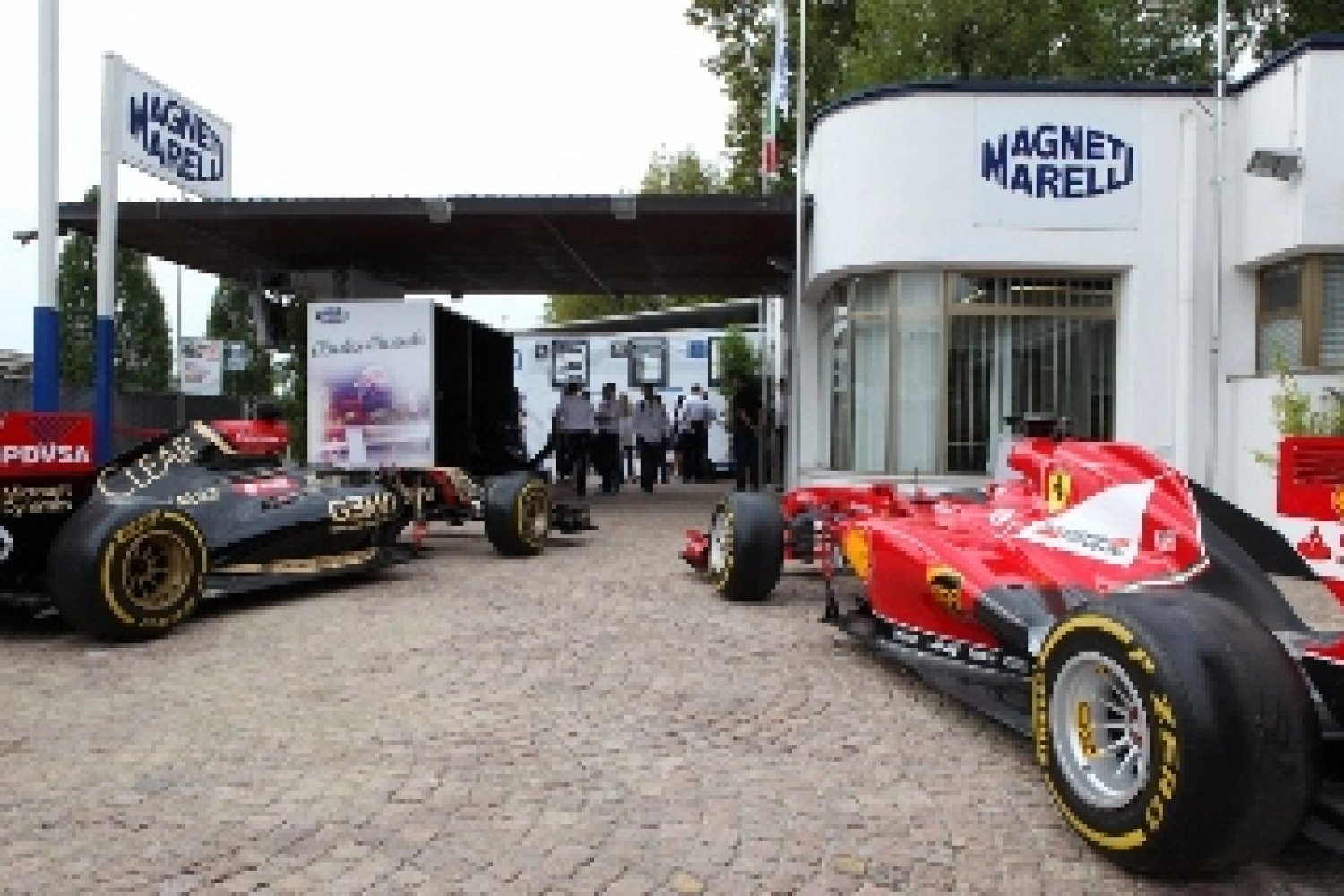
On the occasion of the Italian Grand Prix, we had exclusive access to Magneti Marelli's permanent hospitality area in the heart of the Monza circuit. We were welcomed there by Eugenio Razelli, the company's CEO, and Roberto Dalla, its motorsports director.

The company has a long history with motorsports since they have been an integral part of its business activities since its founding in 1919: « We have been involved in motorsports for almost a century. Over the years, Magneti Marelli has structured itself to manage motorsports not just as a passion but to give them a very clear identity and mission within this immense company that is Magneti Marelli. » Mr. Dalla thus declared.
It is important not to forget that the company generated more than 6 billion euros in revenue in 2013 and employs 37,000 people across 85 sites worldwide. The division led by Mr. Dalla is understandably modest in the scale of this giant: « Unfortunately or fortunately, motorsports are not that significant for us. About a hundred people work on this matter here, but I am proud to say that the importance we have within the company is not trivial. »
The description of Mr. Razelli is thus very clear for the role he expects from this division: « I like to consider motorsports as an island. An island in the sense that it is totally independent and requires a lot of special attention. But at the same time, it must be an island with many bridges to the rest of the world in order to take advantage of all growth opportunities. »
Three missions: innovation, brand promotion, and profits.
The mission he has entrusted to Mr. Dalla and his teams is very clear: « Motor sports must promote innovation. This should allow the company to explore new territories, test new solutions immediately, and assess whether new applications should be developed. »
This presidential directive has been facilitated by the regulatory changes we have seen in many disciplines, starting with F1 over the past few years. Mr. Dalla commented: « Motorsport and F1 in particular are increasingly close to the automotive industry in general terms. Therefore, it is much easier to justify the investments we make in this sector. »
However, the company does not invest in innovation solely for the beauty of the gesture and the love of innovation, but also to promote its brand and expertise, as Roberto Dalla explains: « By working on these jewel-like cars and putting our logo on them, we are able to say that we are involved in the technical aspect of these cars. The fact that we are present in such an environment is a very direct statement of the capabilities within our company. »
The third element of the strategy in this sector is that motorsports are considered a commercial activity like any other within the company: « Profits are an important element for our activity. Obviously, given our size, you can imagine that our profits will not change anything on the scale of Magneti Marelli but, for us, it is important not to waste money in what we do. Ultimately, if we can at least break even, it is a very good thing because it means we do not have to ask for additional money from the CEO. »
More than the money generated in these activities, the interest in being considered as a full-fledged division is that it forces its staff to focus on elements that have market value: « If we don’t pay attention to our profits, we risk reducing our efficiency. »
Three technical elements to develop: powertrains, connectivity, and electronics.
Once we detailed the three main missions of the automotive sports division, we looked into the technical elements that Magneti Marelli offers its clients. The first is related to powertrains: « We have been very involved in developing technologies for many years and even more so in recent years. The hybrid is an important element, but, in general, having smaller, more efficient engines has given us a lot of work. »
During the off-season, Mr. Dalla was concerned that all cars might retire in Australia because the technology was so different and complicated: The challenge we had before us was extraordinary. I am proud to say and report what Mr. Razelli told me about this: I am impressed that everything worked in Australia. Because from an engineer’s point of view, what we did with the teams is extremely impressive.
Indeed, the teams had very little running during the tests, but the different stakeholders were obliged to deliver a spectacle that lived up to the reputation of Formula 1, all within an economic environment that is not the best and most supportive: « Once again, this shows that motorsports are an excellent way to quickly realize ideas. »
A second technical element at the heart of Magneti Marelli’s concerns is connectivity. It is an area where it is very close to the division for production vehicles because many improvements can be made in this field: « Thanks to connectivity, we can improve the safety, performance, and management of the car. » In Formula 1, all the cars equipped by the Italian company are therefore connected to a private network to transfer data through telemetry.
The latest technical element on which the men and women under Mr. Dalla’s responsibility are working is electronics. Indeed, performance is increasingly achieved through electronic elements: « This was our main activity at the beginning, and we continue to progress in this field to enable quick modifications on the cars, but also to have a very clear and detailed view of each of our cars in real-time. »
Manage confidentiality between stables
But the Italian company finds itself in a situation where it must both promote connectivity and ensure the confidentiality of this data since it supplies many competing teams in the paddock. The starting point for each of its products is therefore based on a technology it masters internally before offering it to the teams, knowing it will have to customize and adapt it to the needs of its different clients: « We don’t want to develop a product and then tell the teams: “Here is my product, take it as it is. If it doesn’t suit you, too bad, get another one.” What we aim to do is provide a framework for the teams in which they can develop their own variations. The interest for us is that it also allows us to progress in terms of knowledge and expertise.
The Italian leader thus gives us the example of the electronic unit that now manages the hybrid on F1 cars, which includes two different microprocessors: the first, programmed by Magneti Marelli, is connected to the engine, and the second, programmed by the team, is connected to the car. Two situations can then arise: either the team feels sufficiently powerful in programming and decides to code its own microprocessor. In this case, the supplier knows nothing of what is happening. Or the team also decides to entrust this task to Mr. Dalla’s men.
The hybrid revolution
The last topic we discussed together is the question of hybrids. We can see that many manufacturers have followed the trend started by Toyota in the late 1990s. Now, motorsports are also entering this process, with F1 and endurance as the spearheads: « We are convinced that one day, sooner or later, all automotive competitions will be hybrid. Hybrids are a huge revolution. Like all revolutions, not everything is under control, not everything is understood, but what we know is that since 2008, we understand it better with each passing day. It is the best way to increase the efficiency of powertrains. These efficiency gains for competition will also apply to production vehicles. An electric motor has an efficiency of over 80% while a combustion engine has an efficiency of 25%. It is not possible for this technology not to break through in the future because, even if there are problems, the foundation is solid! We must ensure that this foundation is developed and becomes a standard. »
From our special correspondent in Monza