Long-term test – Alpine A110 Legend: grey dress, blue soul
Motors Inside continues testing dynamic small sports cars, this time with the Alpine A110 "Légende." After 5 days and several hundred kilometers at its wheel, discover our detailed verdict.

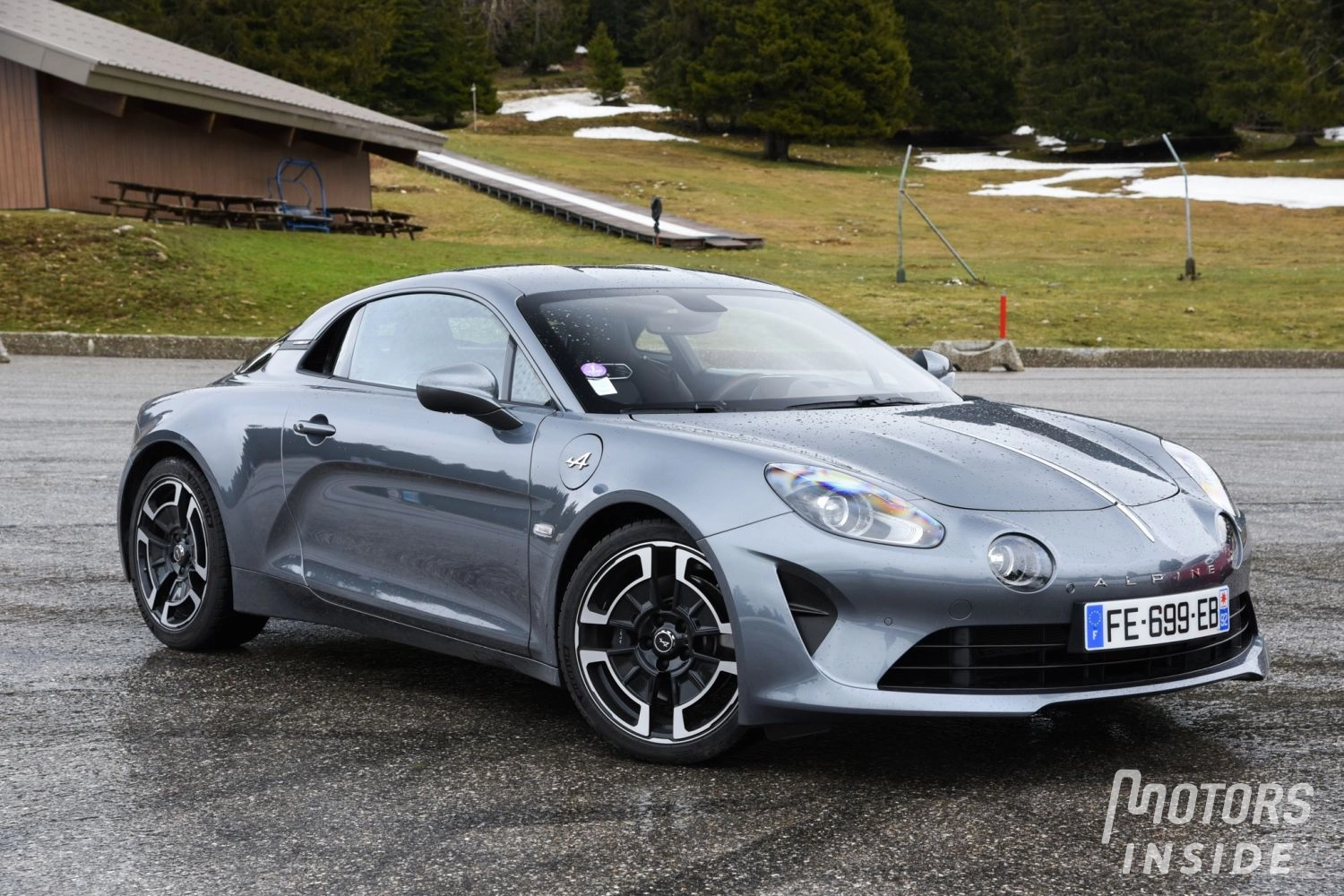
It was at the beginning of April that we received confirmation that Renault agreed to provide us with an Alpine A110 for five days.
We could have settled for one car, but letting the new berlinetta stretch its tires alone on our mountain roads would have lacked daring. So we convinced Alfa Romeo to lend us a 4C for the same period, in order to orchestrate a comparison test between two favorite coupes.
Already thrilled at the idea of getting behind the wheel, we quickly wanted to know the configuration we would have. It was during a preliminary exchange for this test drive that we openly revealed our preference for the “Première Edition” trim and the “Bleu Alpine” color.
It seemed to us that it wouldn’t have been too much to assert itself against the “Rouge Alfa” of the 4C that would stand up to it. Alas, this variant was not available. Our Alpine therefore sported a “Thunder Grey” attire that was as elegant as it was too discreet.
Heading to Annecy, its lake and its incomparable routes.
Shaped in Dieppe, Sharpened for the Alps
This quote from Colin Chapman may not be the most famous of all, but it sums up a principle that is still current. The founder of Lotus was right back in 1957: weight is the key to agility, dynamism, and ultimately victory.
Remember among others the Mini Coopers (620 kg) or Lancia Stratos (870 kg) involved in rallies in the 60s/70s and their achievements.
If for a car with a sporty vocation weight is a determining factor, the distribution of mass is equally important. The A110, in the Legend trim, weighs only 1,123 kg distributed as follows: 56% at the rear with the engine in a central position, 44% at the front with the fuel tank placed behind the axle.
However, it is not the lightest in the range (1,123 kg for the Legend, 1,103 kg for the Premiere Edition, and 1,098 kg for the Pure). Nonetheless, its features and its body made up of 96% aluminum give it rigidity and maneuverability.
In addition to its lightweight architecture, the new berlinetta derives its agility from its double wishbone suspension system. A choice that benefits its handling and stability on uneven surfaces. Its front axle is therefore precise and incisive, even when the brakes are heavily used, it never succumbs to understeer.
The A110 is equipped with Brembo brakes with optional 320 mm discs, and the front aluminum calipers have four pistons. During our test, they proved to be efficient and durable in sustained driving. This assessment only makes sense if we apply the common rule for rear-engine vehicles: braking late enough to slow down to the apex in the middle of the curve, before gradually and fully opening the trajectory.
If some colleagues regretted the absence of a pilot-controlled chassis (even as an option) and found the handling a bit too soft in dynamic driving, that was not our experience. The roll is contained thanks to the work of the hydraulic stops, and no unexpected damping pumping was observed when the car was leaning.
The Alpine entrusts its ground connection to Michelin Pilot Sport 4 tires specially developed for it. The front is fitted with 205/40 ZR18 tires and the rear with 235/40 ZR18 tires.

What the present owes to the past
The general lines of the new Dieppe coupe pay a strong tribute to its ancestor, the mythical berlinette. The design is clear and concise, consisting of a single stroke. Its lines are taut and its curves gentle. Its ideal proportions are endowed by an aluminum body that perfectly fits each mechanical component.
The curves of the front blend with those of the rear via a low and taut waistline, which reveals a cozy cockpit, while skimming over the deep side panels carved into the doors, ending on large sculpted haunches that wrap around the rear wheels. The large curved rear quarter window is also very impressive.
Whatever angle you look at it from, the connection with its illustrious predecessor is evident without overplaying the neo-retro card. This complex and often double-edged stylistic exercise has been perfectly executed here.
Some may criticize it for a lack of boldness as well as for trying to capitalize on a design dating back almost sixty years. Porsche excels in this area with the 911, so why not Alpine?
Tributes to the past are thus sparingly distilled, from the chrome strip on the central rib of the hood (optional), to the quadruple round full LED headlights, and the 18-inch glossy black vintage “Légende” wheels. Only the design of the mirrors seems to have escaped any form of consideration.
The new A110 blends elements of past style with the present thanks to modern features such as the scrolling LED taillights in the shape of an “X”, the diffuser that extends from the flat underbody, and the prominent central exhaust outlet. The designers have captured the spirit of the 60s coupe by reinterpreting an elegant line inspired by the past, which will undoubtedly stand the test of time.

Did you know?
If in the collective imagination a berlinette must be blue, know that the color palette available at Alpine included up to nearly forty shades. So why does this association between the A110 and this famous color still hold true today? The answer most likely comes from the fact that most factory models engaged in rallies raced in this livery. Moreover, there were up to five blue codes: “Bleu alpine métallisé 1,” “Bleu azur métallisé 2,” “Bleu acier métallisé 11,” “Bleu cady 34,” and “Bleu foncé 460.” As a result, many owners had their cars repainted or opted for this shade synonymous with victory and performance at the time of purchase.
Quilted leather and woven carbon
Once on board, you discover a confined cabin with a flattering presentation. The brown leather enhanced with blue stitching reveals the Grand Touring philosophy of the “Legend” trim.
This is affixed to the upper part of the door panels, in a diamond pattern, features a discreet French flag, and is framed by a lacquered composite reminiscent of the body color.
The “Comfort” seats with quilted upholstery and ideal support are designed by Italian manufacturer Sabelt, whose signature is placed on the leather loop where the seatbelt is secured when unfastened. They weigh just over 14 kg. They can optionally be heated and have six adjustment paths. Finding an appropriate driving position will take no more time than the exercise of 0 to 100 km/h (4.5 seconds).
The alternating use of materials such as aluminum, carbon, or leather gives the A110 a more chic than sporty ambiance. Only the “Sport” button positioned at the bottom right of the steering wheel betrays the true vocation of this coupe, designed to swiftly tackle winding roads and climb mountain passes.

The piano keys placed under the touchscreen are ideally positioned and pleasant to use. However, it’s hard to say the same for the multimedia unit, whose integration and ergonomics leave much to be desired.
The floating center console with its beautiful design includes the controls for the gearbox, power windows, start/stop button, electric parking brake, and the cruise control/speed limiter combination.
This single-piece design also conceals one of the few storage spaces. Difficult to access (especially while driving) but rewarding once discovered as it will allow you to place a smartphone and connect it to one of the two available USB ports.
As an option once again, it is possible to choose the “Storage Pack” which includes a net behind the seats and a closable leather compartment that fits between the two bucket seats.

On this topic, although practicality is not a purchase criterion for this type of vehicle, note that the A110 has a front trunk with a capacity of 110 liters, allowing it to accommodate two cabin suitcases, while the rear trunk can hold 96 liters.
Like other elements with unflattering plastic, the automatic climate control and various ventilation systems suffer from a mediocre presentation and are directly taken from mass-produced Renault vehicles. They are the only real criticism that could be made regarding life on board. At over €65,000, it is somewhat disorderly.
Let’s end with the Focal audio system, in its “Premium” version. Beyond its undeniable sound qualities, it is worth noting that this French creation highlights quality materials for some and natural for others, such as the linen membranes sourced from the Dieppe region. The system consists of two open-grid speakers housed in the doors, two tweeters flush with the windshield, an amplifier, and a subwoofer positioned behind the driver’s seat.
Agile and Furious
The heart of the A110 is positioned centrally at the rear. It features a 4-cylinder turbocharged engine with 252 hp, direct injection, with the displacement increased to 1.8 L and maximum torque of 320 Nm from 2,000 rpm to 6,000 rpm. This brand-new engine has been borrowed from the latest Renault Mégane RS (internal code name: M5PT), which extracts 280 hp. It now peaks at 292 hp in the S variant of our coupe.
Although it inherits a heritage rich in success and a name that has become mythical, the new A110 is resolutely in step with its time, perhaps too much so. This is evidenced by the presence of the EDC7 dual-clutch automatic transmission. Purists will lament the lack of a “real” manual gearbox option, while the more conciliatory will readily admit that the aluminum paddles on the steering wheel do an effective job, that the gearing of the EDC7 suits the car’s general philosophy, and that the overall harmony is not compromised.

The Alpine coupe is equipped with a new torque vectoring system. By distributing power between the rear wheels, the system provides maximum propulsion power without ever compromising vehicle stability, even on slippery surfaces.
Like many of its rivals, the Alpine offers “a la carte” sportiness. Several driving modes are available: Normal, Sport, and Track. Depending on each mode, acceleration control, steering assistance, gear shifting, exhaust sound, and the dynamic driving control system (ESC) adjust accordingly. If the Track mode still feels too restrictive, it is possible to completely disconnect the ESP.
Beyond influencing the previously mentioned points, the Sport and Track modes reward your ears with cavernous snarls and pop & bang explosions upon deceleration. As for the turbo’s breath, it becomes more audible as your right foot seeks to reach the ground.
Chic and Restrained Sportiness
The Légende trim is probably not the most suitable to reveal the true philosophy of the new A110, but no matter. It is nonetheless a genuine Alpine: a lightweight, mid-engine, rear-wheel-drive car, ready to tackle winding roads to reach the tops of mountain passes while giving competitors a run for their money.
As easy to handle daily as it is exhilarating to drive on alpine switchbacks, the new berlinette ultimately represents a unique offering in its segment. It strikes a balance while Porsche Cayman or Audi TT become more luxurious, and Alfa Romeo 4C and Lotus Elise become more radical.
Its price starts at €59,700 in the Legend trim, which is €3,900 more than the Pure variant and €900 more than the limited edition of 1,955 units Première Édition. The configuration of our test model even exceeds €65,000, considering its options. With equivalent equipment, the competition falls short and does not offer as much versatility.
In conclusion, its gray robe did indeed conceal the blue soul of its illustrious predecessor, and its sharp gaze indicates that Alpine’s renaissance is only in its early stages…
The figures
| Model | Alpine A110 Légende 2019 |
|---|---|
| Price / from: | 55,800 € (Pure) €59,700 (Legend) + 1,050 € penalty |
| Price of the tested model: | 65,000 € |
| Engine | |
| Engine type: | Petrol turbo Inline 4-cylinder 1 800 cm3 16 valves Direct injection |
| Engine architecture: | Mid-rear position |
| Power: | 252 hp |
| Torque: | 320 Nm from 2,000 rpm |
| Gearbox: | Automatic dual-clutch 7 gears |
| Transmission type: | Propulsion |
| Characteristics | |
| Front / rear suspensions: | Double wishbone |
| Front brakes: | Ventilated discs (320 mm) Fixed stirrups 4 pistons |
| Rear brakes: | Ventilated discs (320 mm) Floating calipers Mono piston |
| Front / rear tires: | Front: 205/40 ZR18 Rear: 235/40 ZR18 Performances 0-100 Km/h: 4.5 seconds Weight and measures Dimensions: 4,180 mm (L) 1,798 mm (l) 1,252 mm (H) 2,420 mm (wheelbase) |
| Trunk volume: | Front: 100 L Rear: 96 L Rear: 44% |
| Number of seats: | 2 |
Positive Points
- Lightness, agility, weight distribution;
- Chassis and suspension;
- Full and fierce engine;
- Engine/gearbox pleasure;
- Unique and timeless design;
- Versatility (dynamism vs. comfort);
- Driving modes.
Negative Points
- Slow and imprecise navigation system;
- Some finishes and plastic qualities on the lower parts of the cabin;
- Basic and unflattering Renault controls;
- Reverse camera display replacing the gauges. Really not practical when maneuvering and turning the steering wheel. Why wasn’t it simply integrated into the touchscreen…?
- Having to return the keys.