Long-term test – Alpine A110S: with an “S” for “Scalpel”
To stand up to the competition and elevate its range, the Alpine A110 raises the stakes and adds the "S" label. That was enough to pique our curiosity. Discover our full-scale test conducted over 1 week on the roads of Haute-Savoie and the Vercors.

Over a year ago, we had the pleasure of getting behind the wheel of the Alpine A110, in its “Légende” version, for a long-term test and a comparison with the Alfa Romeo 4C “Edizione Speciale”. This year, we decided to test the full potential of the new “S”.
It took almost 2 years after the presentation of the new A110 at the Geneva Motor Show in March 2017 for Alpine to enrich its range with a more refined version.
Many at the time mistakenly assumed that its initial power of 252 hp would be insufficient to compete with its rivals.
This was without taking into account the efficiency of its engine, its lightness, its agility, and the ideal distribution of its masses, which have earned it almost twenty international awards to date.

On paper, the “S” boasts a power gain of 40 hp, a stiffer chassis, and a contained weight. It aims to be more sporty and radical than the “Pure,” “Légende,” and “Légende GT” (limited to 400 units) but less original than the “Color Edition 2020 – Jaune Tournesol” (a time-limited series produced only in 2020) that is technically identical.
She also commits to respecting the founding and timeless principles of Alpine, which are: lightness, compactness, agility, and real everyday comfort.
But given the intrinsic qualities of the original 2017 model, does this newcomer have any reason to exist other than to satisfy the most demanding customers?
Conception
The A110, in the “S” trim, weighs only 1,114 kg. Some (expensive) options even allow the weight to be reduced to 1,107 kg: the “Fuchs” forged wheels (€1,008) offer a reduction of 5 kg, while the carbon fiber roof (€2,400) and seat backs adorned with the same material (€1,800) save an additional 1.9 kg. The weight distribution remains unchanged: 56% at the rear with the engine in a central position and 44% at the front with the fuel tank located behind the axle.
Despite the financial efforts you might grant it, it is still not the lightest in the range (1,103 kg for the “Première Édition” at the time and 1,098 kg for the “Pure”). Its bodywork, still composed of 96% aluminum, however, provides it with as much rigidity and maneuverability as its counterparts.
The exemplary handling and impeccable stability of the Dieppe coupe are still ensured by a double wishbone suspension system. The front axle is remarkably precise and shows no tendency to understeer, even during (very) dynamic driving.

The Alpine A110S is equipped with high-performance Brembo brakes, with discs measuring 320 mm (standard), and orange aluminum calipers featuring four pistons at the front. During our various outings, they proved to be very effective and durable at high speed; however, we found that they need to be strongly engaged to fully exploit their potential. The diving of the front end during braking is much better contained than on the “Legend” model.
Beyond the engine block’s power increase, it is the optimization of the chassis and suspensions that truly set this new Alpine apart from the rest of the range. The anti-roll bars, now hollow to minimize weight, have been stiffened by 100%, the stiffness of the stabilizer bars has been doubled, and the new coil springs with hydraulic stops have been made 50% more rigid. The engineers from the Normandy-based firm have also lowered the ride height (and thus the center of gravity) by 4 mm.
The A110S rests on Michelin Pilot Sport 4 tires widened by 10 mm. The front axle is thus fitted with 215/40 R18 tires while the rear is equipped with 245/40 R18 tires.

Exterior design
At first glance, distinguishing an “S” from the rest of the A110 range is not the most obvious. Its body kit is strictly identical to the other versions, and no aerodynamic appendage has been granted to it. So don’t expect a front splitter, side skirts, spoiler, or carbon diffuser, even as an option.
The Dieppoise is satisfied with a few rare series elements that are specific to it:
- “Alpine” lettering painted in black on the front and rear faces;
- “A” logos painted in black on the front fenders (including the fuel cap on the right side), above the turn signal repeaters;
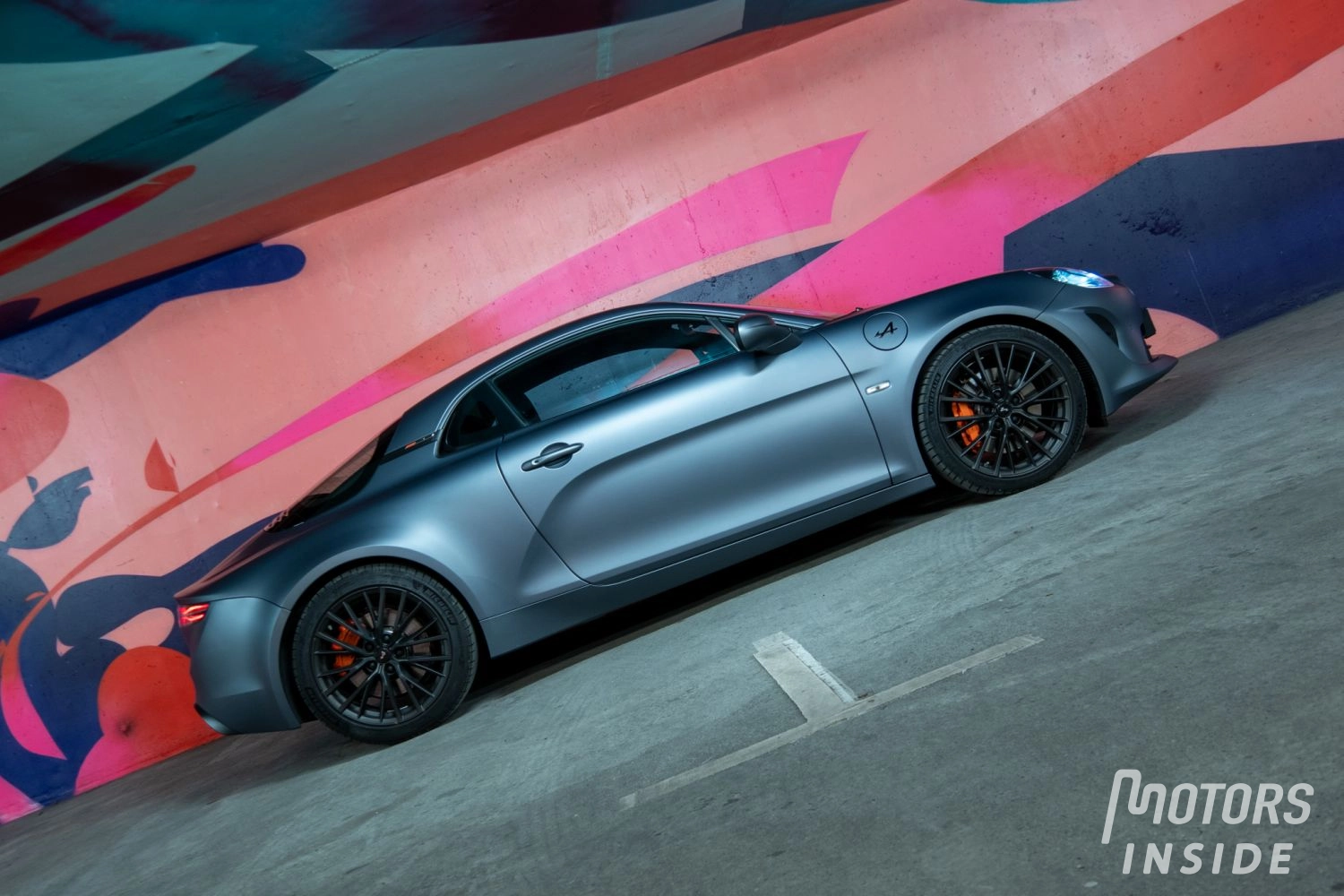
- aluminum brake calipers painted in orange;
- 18-inch “GT Race” matte black wheels;
- carbon fiber and orange inserts on the side strips that connect the quarter windows to the rear window.

Our test model was equipped with a “Matte Thunder Gray” paint, an option charged at €4,800. While this shade beautifully complements the shapes of the new coupé, it will not be enough to satisfy customers seeking exclusivity and differentiating markers, especially since this color is available as an option on any model in the range.
Without going so far as to consider that the exterior treatment of the “S” was given no thought, we can legitimately question the intentions of the design teams who seem to have neglected any form of boldness.
Life on board
The initial equipment of the latest Alpine model is logically more generous than that of the “Pure.” Once inside, you find a dark, almost austere interior, but it is rather well equipped. It comes standard with:
– a roof lining and windshield pillars covered in an Alcantara substitute (“Dinamica” microfiber) which is quite pleasing to the eye and soft to the touch;
– bucket seats (with fixed backs in this variant) still supplied by the Italian manufacturer Sabelt. Already stunning, these can be optionally enhanced (1,800 €) with carbon shells. They are adorned with black leather and “Dinamica” as well as orange stitching;
– a steering wheel receiving the same treatment as the seats and now featuring an orange center point;
– carbon fiber and orange inserts replacing the blue, white, red flags at the top sections of the door panels;
– door panels covered in “Dinamica” instead of quilted leather;
– a driver pedal set and a passenger footrest in aluminum;
– matte carbon elements;
– a high-end Focal audio system.

Like the exterior treatment of this more radical version, the interior changes of the A110S are hardly noticeable. We still appreciate the sporty atmosphere of this confined cabin and once again regret:
- some hollow and really unflattering plastics;
- basic control stalks from mass-produced Renaults;
- an impractical location for window switch buttons, electric parking brake, and cruise/limiter control;
- a multimedia unit whose integration and ergonomics still leave much to be desired;
- fixed and too small paddle shifters.

Motorization and road behavior
You’ve understood it, the anecdotal changes made to the general presentation of the A110S don’t particularly suggest a revolution on the road, but what is the reality?
No need to maintain suspense for too long: at a moderate pace, the 40 hp more powerful turbocharged 4-cylinder presents no perceptible difference from its more modest variant.
However, the original 1.8 L engine from Renault (internal code name: M5PT) sees its turbo pressure increase to reach 2.4 bars (+ 0.4 bar) and its power rise from 252 hp (at 6,000 rpm) to 292 hp (at 6,400 rpm). The maximum torque, however, remains stagnant at 320 Nm, as the EDC7 automatic dual-clutch transmission cannot support more.

Performance is still good but not drastically better. Thus, the 0 to 100 km/h sprint is now completed in 4.4 seconds (compared to 4.5 seconds), the top speed peaks at 260 km/h (10 km/h more), and the 1,000 m standing start is done in 22.8 seconds (compared to 23.2 seconds).
The additional 40 hp do not transform the Alpine A110S, at least not in “Normal” mode… We quickly understood that only the red “Sport” button, located at the bottom right of the steering wheel, would provide answers to our questions.
Once engaged, the berlinette reveals a completely different character from its counterparts: the steering stiffens, acceleration response time is significantly reduced, the exhaust opens up, gears stretch to the redline and shift in the blink of an eye, acceleration is extremely efficient, the sound pipe rewards you with growls and pops with every deceleration… and one can finally appreciate the full interest and potential of this variant.
But although the developments made to the engine block and the gearbox finally prove themselves in “Sport” mode, it is especially the optimizations made to the chassis and the suspensions that are the most notable.
If in some respects we could criticize the “Legend” for being too soft and for the front end tending to dive during intense braking phases, that’s no longer the case with the “S”.

The cash flow movements are perfectly contained, body roll is minimized, the steering is ultra-sharp, and the road holding is impressive. The Dieppe coupé leaps from one corner to another with disconcerting agility, it seems glued to the ground. The rigidity of the chassis is reassuring but also involves more lively reactions and therefore requires increased attention.
The firmer suspensions, on the other hand, will allow you to fully enjoy the dynamic qualities of the A110S but also to quickly gauge the size and exact number of gravel scattered on the roads you take. As for speed bumps, it’s better to approach them at a snail’s pace unless you have an advantageous loyalty program with your osteopath. While it shakes its passengers a bit more, the “S” remains enjoyable for daily use.

Did you know?
The original berlinetta designed by Jean Rédélé had no less than 12 different engines over its 14-year career (from 1963 to 1977). The first model of the Alpine A110 to add the letter “S” to its name was the 1300, produced from 1966 to 1971. The “S” stood for “Super” at that time.
Below is the list of all its engines:
| Nom | Année | Modèle | Moteur | Cylindrée |
|---|---|---|---|---|
| A110 956 | 1963-65 | – | R8 | 956 cm3 |
| A110 1100 « 70 » | 1964-69 | 1100 VA | R8 Major | 1 108 cm3 |
| A110 1100 « 100 » | 1965-68 | 1100 VB | R8 Gordini | 1 108 cm3 |
| A110 1300 « Super » / S | 1966-71 | 1300 VB | R8 Gordini | 1 296 cm3 |
| A110 1300 / 1300 G | 1967-71 | 1300 VA | R8 Gordini 1300 | 1 255 cm3 |
| A110 1500 | 1967-68 | – | Lotus Europa R16 | 1 470 cm3 |
| A110 1600 | 1969-70 | 1600 VA | 16 TS | 1 565 cm3 |
| A110 V85 / 1300 | 1970-76 | 1300 VC | 12 TS | 1 289 cm3 |
| A110 1600 S | 1970-71 | 1600 VB | 16 TS | 1 565 cm3 |
| A110 1600 S / SC | 1972-75 | 1600 VD | 16 TS* | 1 605 cm3 |
| A110 1600 SI | 1973-75 | 1600 VD | 17 TS injection | 1 605 cm3 |
| A110 1600 SX | 1976-77 | 1600 VH | 16 TX | 1 647 cm3 |
Conclusion
The Alpine A110S is of surgical precision, and there is no need to have “studied medicine” to fully enjoy it. However, it is not the best of them all and does not prove to be radically more efficient than the other models in the A110 range; it is simply different.
This version will allow you to push your limits even further and proves to be an ideal ally if you spend your weekends on tracks looking for the best lap time. If, on the other hand, this prospect does not even cross your mind, turn to the other models from the Dieppe firm.

As far as we are concerned and despite the undeniable qualities of the “S” (sold from €67,900), we still cannot justify the nearly €11,000 difference that separates it from the “Pure” (sold from €57,000). If such a budget were allocated to us to acquire an Alpine, we would opt without any hesitation for an A110 “Pure” equipped with €11,000 worth of options.
The brand’s managers, however, had the foresight not to force their customers to pay a hefty price to enjoy the best of Alpine. They preferred to expand their offerings by proposing a model that is certainly sharper, but above all different and complementary to the rest of the range. Everyone will find their fit, even though the beautiful Normande charges a (very) high price for its services, at the risk of forgetting that at this price level, potential clients might justifiably look towards Stuttgart…
The numbers
| Modèle | Alpine A110S 2019 |
|---|---|
| Prix / à partir de: | 57 000 € (Pure) 61,000 € (Legend) 67,900 (S) €69,300 (Légende GT) 71,000 € (Color Edition 2020) + €1,276 penalty (in 2020) Model tested price: €73,794 Engine Motorization: Turbo gasoline 4-cylinder inline 1,800 cc 16 valves Direct injection |
| Engine architecture: | Mid-rear position |
| Power: | 292 hp |
| Torque: | 320 Nm from 2,000 rpm |
| Gearbox: | Dual-clutch automatic 7 gears |
| Transmission type: | Propulsion |
| Specifications | |
| Front/rear suspension: | Double wishbone |
| Front brakes: | Ventilated discs (320 mm) Fixed stirrups 4 pistons |
| Rear brakes: | Ventilated discs (320 mm) Floating calipers Mono piston Front/rear tires: Front: 215/40 ZR18 Rear: 245/40 ZR18 Performances 0-100 Km/h: 4.4 seconds Top speed: 260 km/h Urban cycle: 8.8 L/100 km Extra-urban cycle: 5.2 L/100 km Combined cycle: 6.5 L/100 km Weight and measurements Dimensions: 418 cm (L) 179.8 cm (w) 125.2 cm (H) 242 cm (wheelbase) |
| Trunk volume(s): | Front: 100 L Rear: 96 L |
| Tank: | 45 L |
| Unladen weight: | 1,114 kg |
| Weight distribution: | Front: 56% Rear: 44% |
| Number of seats: | 2 |
Positive points
- Lightness, agility, and mass distribution;
- Chassis optimization;
- Firmed suspensions;
- Full and fierce engine;
- The efficiency of the EDC7 gearbox;
- Exceptional road holding;
- Playful behavior;
- Timeless design;
- Goodwill from passersby:
If one might fear speaking to a supercar owner, the “small sports cars” preserve a form of social connection that brings a smile to every encounter.
Negative points
- The body kit and interior presentation are not distinctive enough from the rest of the Alpine range;
- The multimedia interface is unworthy of a car priced at nearly 70K€;
- The location of the window lift and cruise/speed limiter buttons is really impractical. We once pulled the handbrake while driving, thinking we were raising a window…
- At night:
The absence of electrochromic exterior mirrors (even as an option) results in repeated glare;
The backlighting of the buttons on the steering wheel and center console is simply non-existent. It’s quite simple, you can’t see anything unless you turn on the overhead light; The anxiety-inducing oil level warning if you park on a slope for more than 5 minutes; Access to the engine compartment. At this price, a hydraulic strut and a simple button to lift the rear window would have been welcome instead of basic nuts that are difficult to access; The slightly high fuel consumption in normal driving for such a light vehicle, equipped with a “small” 4-cylinder and a 7-speed dual-clutch automatic transmission; The seat back adjustment can only be done with tools; The high price compared to the competition / compared to its own range.
The photos of our test