Reconstruction: Grosjean’s accident in 3D
Romain Grosjean's accident two weeks ago on the first lap of the Bahrain Grand Prix shocked by its magnitude. It is difficult to understand how the single-seater could have remained stuck in the safety barriers. More details thanks to this 3D animation.

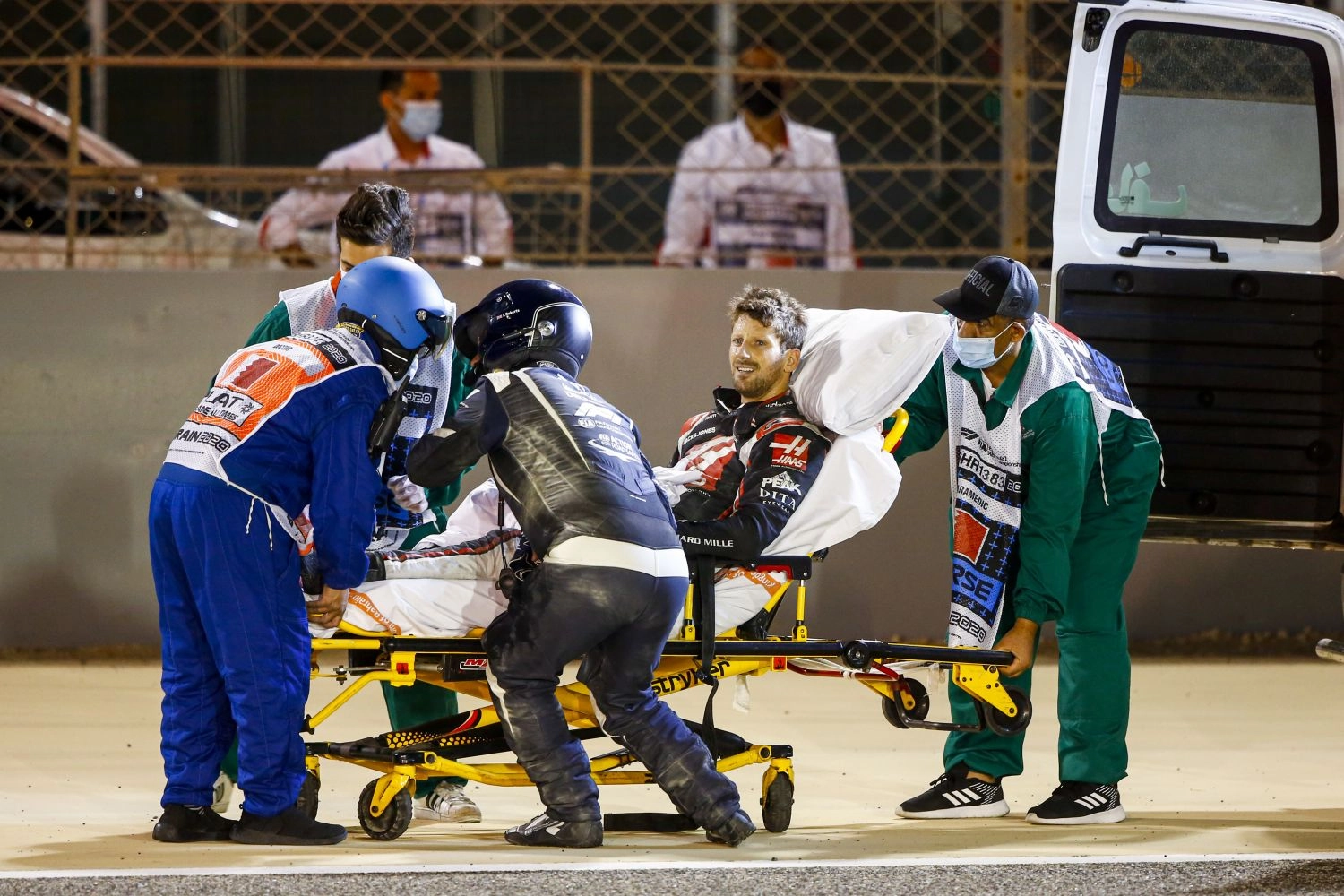
The terrible accident suffered by Romain Grosjean in Bahrain was shocking. The driver has been since discharged from the hospital with some burns, mainly on his hands. An article already reviews what saved Romain Grosjean from his accident, but here we will analyze the crash differently thanks to an unofficial 3D reconstruction.
Warning: This article is in no way an official reconstruction and the FIA will conduct a thorough investigation into the accident, the results of which will be known in a few weeks.
Step 1: The impact angle with the rails
On this first screenshot of the video at the bottom of the article, we can clearly see the angle of impact between Romain Grosjean’s car and the safety barriers. Safety barriers which are not parallel to the layout of the circuit but come slightly inside to allow a runoff area and an intervention zone for the marshals a few tens of meters further down the track.
This impact angle is estimated at about 65°. Let’s go back to the importance of safety barriers (also called guardrails). These guardrails, as their name suggests, allow any object colliding with them to slide on the metal. The force of the impact is then spread over several meters rather than being accumulated at one point. But for this to work, the angle of the impact must be less than 90°. With an impact at 65°, several rows of tires, or techpro, would have been more effective in absorbing the impact.

Step 2: Penetration between the rails
As shown in the following image, it is the front wing, the front-right suspension triangles, and the chassis that mainly absorbed the violence of the 53G impact (according to the sensors). A single-seater is equipped with materials to absorb impacts at the front of the safety cell (the cockpit). But the first appendages to undergo an impact are the wings and the nose which must themselves pass the FIA crash tests. Single-seaters are therefore rather well equipped to withstand a frontal impact. But at 220 km/h, we can salute the progress made by the FIA on this point.

The single-seater car was unable to slide on the safety barrier, so it started to deform the safety barriers (reinforced by metal pillars themselves sealed in the ground).
The technical specifications of the FIA are very clear. A safety barrier in accordance with FIA STANDARD 3501-2017 must be between 1m and 1.2m high. This means that with three safety barriers per fence, there is a gap of about 40 cm. The barrier was therefore the weakest at this height. And yet it was at this height that the impact occurred with the barrier, precisely between two pillars. This is where the metal is most likely to give way.
How are crash tests carried out by the FIA?
« The maximum acceleration measured on the trolley in the direction of impact (X axis) must not exceed -50 G. » explains the FIA document. Here, an impact of 53G for the driver is mentioned. This implies an impact with the monocoque that is likely much more significant.
Indeed, the FIA is planning a test at a maximum speed of 165 km/h. That is 55 km/h below the speed of Romain Grosjean’s crash.


Step 3: The role of the halo
The halo was designed in December 2017 as a result of crashes involving direct impacts on the drivers’ helmets. Mainly the accidents of Jules Bianchi in Japan in 2014 and that of María de Villota during tests with Marussia in 2012.

The halo was designed to protect the driver’s head while allowing them to exit the single-seater almost as easily as without the device. As shown in this photo, it is therefore in the shape of a wave rising above the helmet and then gradually decreasing to reach a vanishing point located lower than the driver’s head. Intended to withstand monstrous forces, it allowed in Grosjean’s case to protect the driver’s head when the single-seater crashed between the guardrails.

The cockpit could very well have continued its path through the rails and ended a few meters inside the track, but it was stopped by the top of the survival cell that protects the drivers in case of rollover, also made of an extremely resistant steel alloy.
Step 4: The breakdown of the single-seater and the fire or the opposite?
First, it is necessary to know that the chassis of a single-seater is not in one piece. The front of the single-seater is securely attached via the back of the cockpit to the power unit. An F1 single-seater is therefore divided into two parts. The rear with the power unit. The front with the cockpit.
During the crash, the cockpit having plunged into the safety rails at a 65° angle, the shock absorption had to be both frontal and lateral. The frontal force was canceled out by the deformation and opening of the safety rail, only the lateral force continued. Hitting the safety rail in its center, the single-seater car was therefore split in two. But this does not explain the fuel tank leakage.

The Formula 1 fuel tank is positioned under the cockpit and designed to withstand significant shocks and deformations. However, the tank here was punctured by a piece of metal from the safety barrier, or perhaps a debris from the left front wheel suspension triangle. Once the fuel was spread, it only took a heat source like the brakes or a spark from the metal barriers to ignite the fuel. The brakes reach temperatures over 1000°C.
Has the tank been pierced or have the fuel lines caused the fire?
Based on F1 helicopter videos, we can see that the first appearance of a flame comes from the center of the car. If only the “residue” of fuel in the pipes had caught fire, the fire would have spread at a slower rate and especially, the rear part of the car split in two would not have caught fire as well.
In the video, we can clearly see that the rear parts of the single-seater more than 3 meters away are on fire. This suggests that the fuel had spread before the single-seater split in two. It is therefore more likely that the fuel tank was pierced initially by the lateral impact, and then contributed to the splitting of the single-seater, protecting the driver from an even more violent impact. Paradoxically, this stage of the crash allowed for the release of significant force, probably protecting Grosjean from more serious physical injuries.
Step 5: Pilot extraction
Still lucid in his cockpit and in one piece thanks to the Halo, the driver struggled to get out of his cockpit. Drivers are tested by the FIA and regularly trained to detach and get out of their seat as quickly as possible. The introduction of the halo has caused some additional difficulties, but in no case are the tests performed by simulating an obstacle above the driver. However, this is indeed the case here since Grosjean was blocked by the upper safety barrier just above his helmet. Despite being detached, he reportedly needed three or four attempts to find a way out of the cockpit. Unable to look above his head, he was very fortunate at this stage of the crash. First, that the barrier got stuck while allowing an exit, and then to find this exit despite the size of the helmet.

The 3D reconstruction video
Thank you and congratulations to Crashalong for this 3D animation which represents, while waiting for the official analysis from the FIA, one of the best sources of analysis.