Is the F1 safety car too slow for the drivers?
Exclusive interview with F1 safety car driver Bernd Maylander for Motors Inside. We discussed the topic of the safety car speed sometimes criticized by the drivers. Maylander expressed himself on this subject with relevance and honesty.

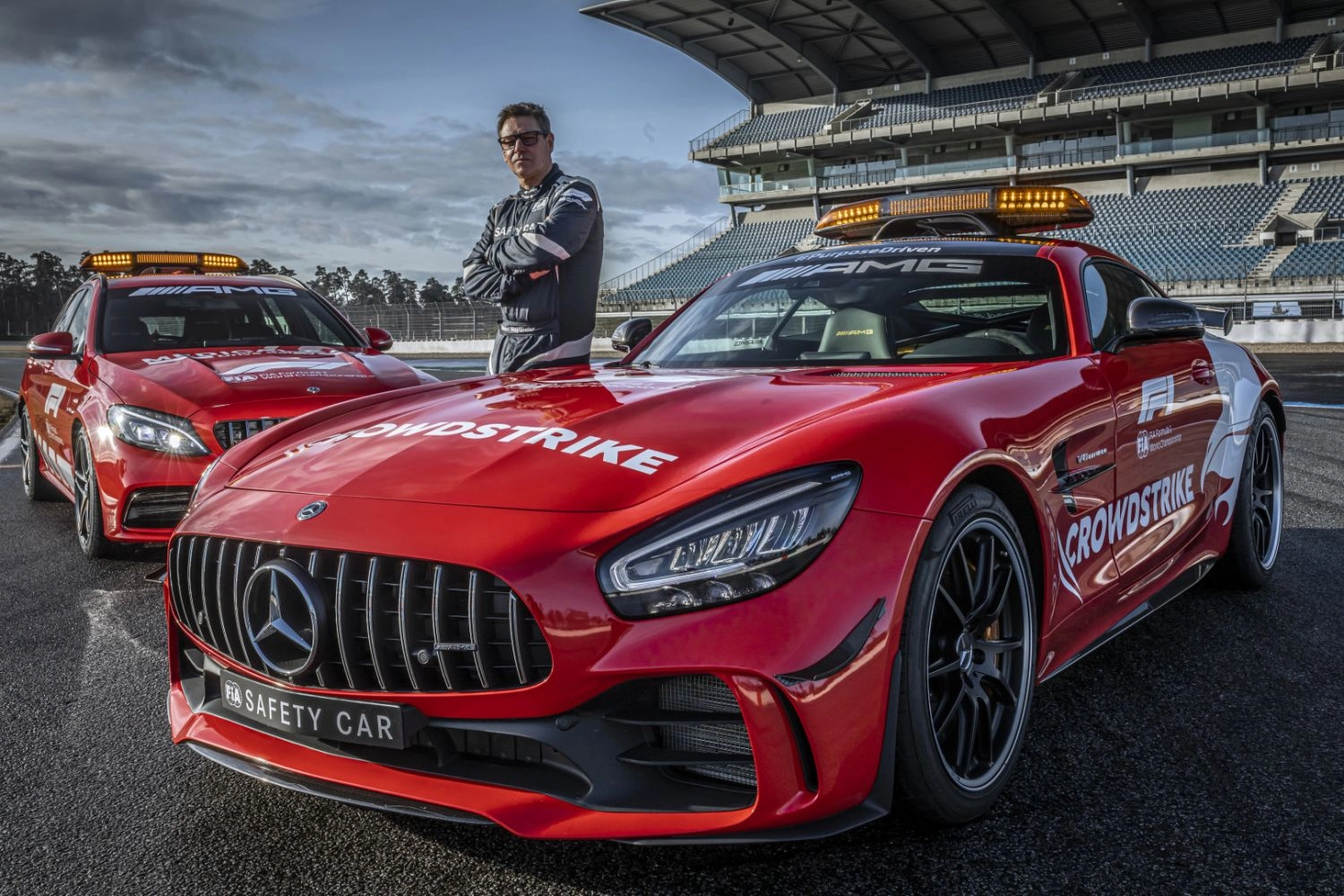
It is a scene we all know, the driver complaining on the radio about the safety car’s slow speed. This was the case at the 2020 British Grand Prix, where Lewis Hamilton and Charles Leclerc felt the need to share their views on the pace they deemed too slow.
The reason for these grievances is that drivers must keep their tires at the right temperature, in the best possible window so that they are not too cold at the restart. It is part of the competition to manage to keep one’s tires in the best possible conditions, despite the slow pace.
Despite the very high performance of safety car models, they are no match for the racing cars that are Formula 1. So logically, for the drivers, the pace seems very slow.
However, Bernd Mayländer is by no means the sole decision-maker regarding the pace to follow. All decisions are made collectively among all the safety personnel. When the safety car is deployed, it means there is danger on the track. Therefore, it is important to ensure the safety of the drivers and therefore to adjust one’s pace accordingly.
Mayländer can understand their frustration at times. However, safety remains paramount and, as mentioned earlier, he is not the only one to judge. Bernd confided in us that sometimes, especially in rainy conditions, he asks his copilot if he can increase the pace and he answers him that he cannot, that he is already at the limit of his car.
Managing rain for the safety car driver is difficult. Although Bernd Mayländer expressed his attraction to these conditions when he was a driver:
« When I was a pilot, I loved rainy conditions because it represented a new challenge. » It’s a whole different story when one is in a position of having to preserve the safety of the pilots. They must convey information about the track conditions to the race management. It is the latter that makes the decision, which makes sense, as it can also align with the pilots’ feelings. The safety car driver is already in discussion with many people on the radio.
« I give my point of view to the race direction. (…) All the people in charge of safety evaluate the conditions,” Bernd explains.
We can gather a lot of information about the weather thanks to the radar. This still remains different from the sensations one can have on the track and it is my role to convey this feeling to the race management, knowing that I am not driving in exactly the same conditions as the drivers.
It seems obvious that driving in the rain will still be different behind the wheel of a safety car, compared to driving a Formula 1 car.
« It is my role to relay my feelings to the race management »
In short, the safety car, as well as its driver and co-driver, are essential elements of Formula 1. Without this safety car, the Grand Prix races could not take place. It aims to ensure, through its presence – as well as through all the means at its disposal – the safety of the drivers and the sport as a whole.
We would like to thank the FIA and Bernd Mayländer for allowing us to speak with them and for teaching us a little more about this wonderful profession of Safety Car driver, a key element of safety in F1.