Aston Martin is testing a new spoiler that goes against the philosophy of the regulations
Aston Martin surprised the world on Friday during Free Practice 1 by introducing an innovation: its rear wing. We will analyze this novelty and assess its legality.

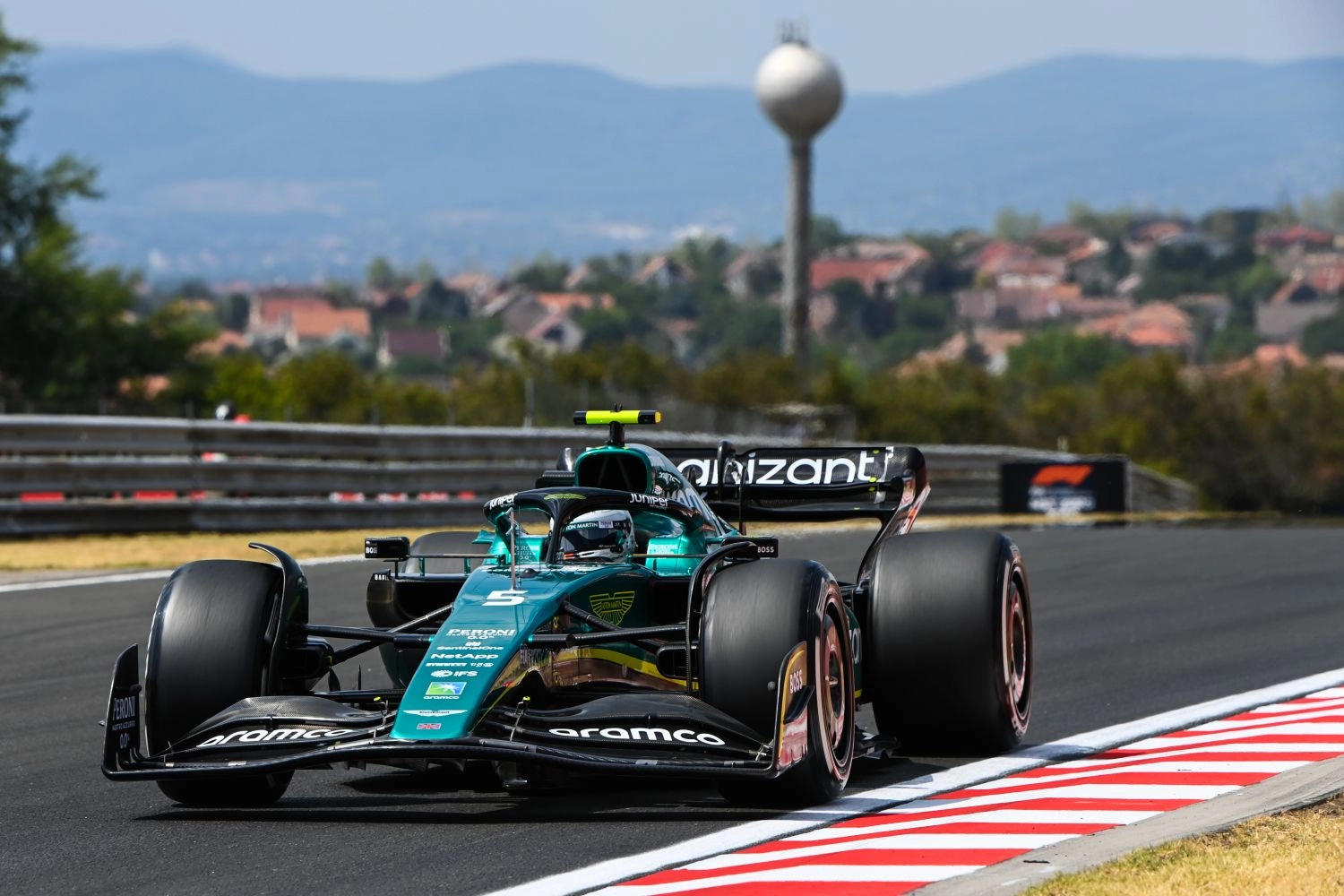
In order to avoid aerodynamic disturbances and allow other cars to follow more easily, the goal of the FIA with the new technical regulations was to reduce vortexes, which are the source of these disturbances. To achieve this, engineers have determined that a rounded rear wing would help contribute to reducing air flow disturbances.
Aston Martin has just exploited a grey area of the regulation. Their new rear wing, which was tested during Free Practice 1 in Hungary, strictly adheres to the requirement that the vertical edge of the wing must be rounded. However, it does not fully comply with the regulatory philosophy aimed at reducing aerodynamic disruptions.
In concrete terms, Aston Martin has extended the height of the rear wing mounting arms. On each side, instead of being made of one piece, the rear wing is divided into two sections. One section continues to rise while the other joins the horizontal wing.
Here we can see the classic rear wing, used by Aston Martin since the beginning of the season and with the same approach as all the other teams on the grid.


The rounded edge on the vertical pillar is only present to comply with the technical regulation, which specifies that the wing’s edge must be rounded to allow for a reduction of vortices and thus aerodynamic disturbances.
The FIA has not yet made any announcement on the subject, but teams have the right to test new parts during the trials, even without obtaining systematic approval. If Aston Martin can prove that this solution does not disrupt the aerodynamic flow any more than the others, it is very likely that they will be allowed to keep it during the race.