The F1 cars are slower than last year in qualifying at Jeddah
Considering the Red Bull and Ferrari leaders, F1 cars are slower in 2023 than they were in 2022. Perez set a slower time, as did Leclerc or his teammate. However, significant disparities are being highlighted.

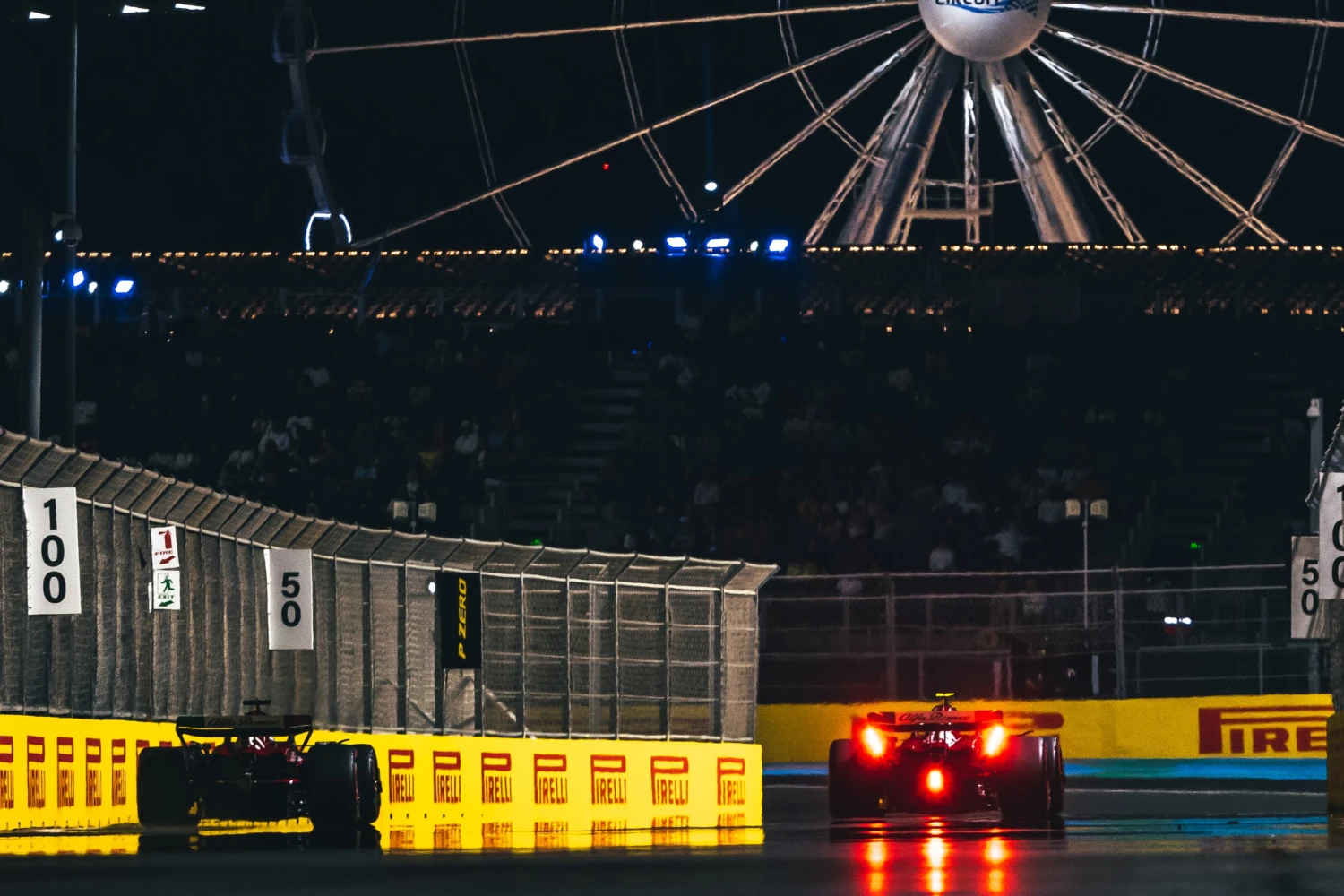
Out of 13 drivers who had a recorded time at the helm of the same team as last year, it is observed that 9 of them are slower in 2023. Only 4 drivers improve their time, including Aston Martin, Williams, and Alfa Romeo.
7 drivers did not take part in the 2022 qualifying or were not in the same team last year. This concerns Alonso, who was at Alpine; Gasly, who was at AlphaTauri; Hülkenberg, who was at Aston Martin, and the other drivers did not drive: Piastri, Tsunoda, De Vries, and Sargeant.
Out of the 13 drivers where the times are thus comparable, it is observed that they are on average 45 thousandths of a second faster if we do a simple average calculation. However, in reality, we observe anomalies. Hamilton did not understand his Mercedes in 2022 and did not make it to Q3. He improved his qualifying time this year by over a second.
Verstappen, on the other hand, is 3 tenths slower than in 2022, but he was unable to participate in either Q2 or Q3, even though his time in Q1 was faster than in 2022. Therefore, he could have set a better time.
We can observe the significant improvement of Aston Martin. Stroll, who did not make it past Q2 last year, gains 1.3 seconds on his 2022 time. It is clearly the biggest progression of the grid. Guanyu Zhou, a rookie last year, improves his time by 3 tenths. This improvement can be attributed to experience, as Bottas, for his part, does not improve and is even 4 tenths slower than last year.
Finally, Williams takes a step forward with 5 tenths gained on Albon’s time compared to last year.
In the end, on average, Formula 1 cars improved their lap time by 45 milliseconds, but 9 drivers posted a slower time than in 2022, compared to only 4 who improved.
This trend is completely different from that of Bahrain where the qualifying drivers had greatly improved their times. We can attribute this difference in trend to the fact that everyone was still discovering the new generation of F1 cars in Bahrain in 2022, while the drivers already had some experience in Jeddah.
We can also note a slight change in the layout due to the new speed bumps which cause a loss of a few kilometers per hour but not significant.
Comparisons of Qualifying Times 2023 vs 2022
| Drivers | Meilleur Times 2023 | Meilleur Times 2022 | Gap | |
| 1 | Perez (Red Bull) | 1:28.265 | 1:28.200 | +0.065 |
| 2 | Leclerc (Ferrari) | 1:28.420 | 1:28.225 | +0.215 |
| 3 | Alonso (Aston Martin) | 1:28.730 | Autre équipe | |
| 4 | Russell (Mercedes) | 1:28.857 | 1:29.104 | +0.247 |
| 5 | Sainz (Ferrari) | 1:28.931 | 1:28.402 | +0.529 |
| 6 | Stroll (Aston Martin) | 1:28.945 | 1:30.256 | -1.311 |
| 7 | Ocon (Alpine) | 1:29.078 | 1:29.068 | +0.010 |
| 8 | Hamilton (Mercedes) | 1:29.223 | 1:30.343 | -1.120 |
| 9 | Piastri (McLaren) | 1:29.243 | Non partant | |
| 10 | Gasly (Alpine) | 1:29.357 | Autre équipe | |
| 11 | Hülkenberg (Haas) | 1:29.451 | Autre équipe | |
| 12 | Guanyu (Alfa Romeo) | 1:29.461 | 1:29.819 | -0.358 |
| 13 | Magnussen (Haas) | 1:29.634 | 1:29.546 | +0.088 |
| 14 | Bottas (Alfa Romeo) | 1:29.668 | 1:29.183 | +0.485 |
| 15 | Verstappen (Red Bull) | 1:28.761 | 1:28.461 | +0.300 |
| 16 | Tsunoda (AlphaTauri) | 1:29.939 | Non partant | |
| 17 | Albon (Williams) | 1:29.994 | 1:30.492 | -0.498 |
| 18 | De Vries (AlphaTauri) | 1:30.244 | Non partant | |
| 19 | Norris (McLaren) | 1:30.447 | 1:29.651 | +0.796 |
| 20 | Sargeant (Williams) | 2:08.510 | Non partant |
Qualification results
Perez takes pole position ahead of Leclerc (penalized) and Alonso.