Two years after the mock Grand Prix of Belgium, the situation could happen again
At the end of August 2021, the Belgian Grand Prix takes place on a rainy Sunday. The very bad weather conditions will cause a three-hour delay, and eventually, the F1 cars will only complete two laps. Two years later, the FIA is still working on a rain kit, far from being ready.

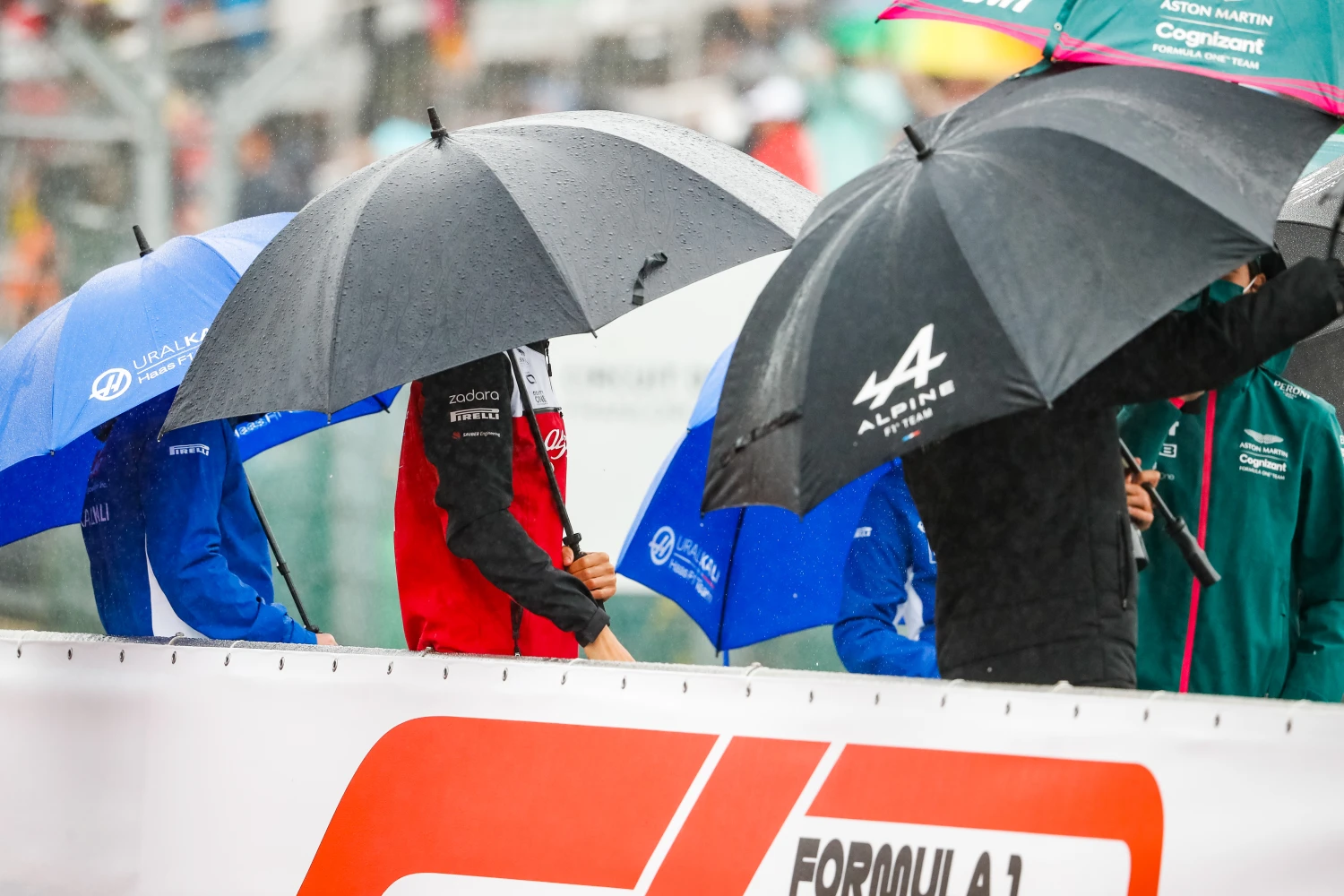
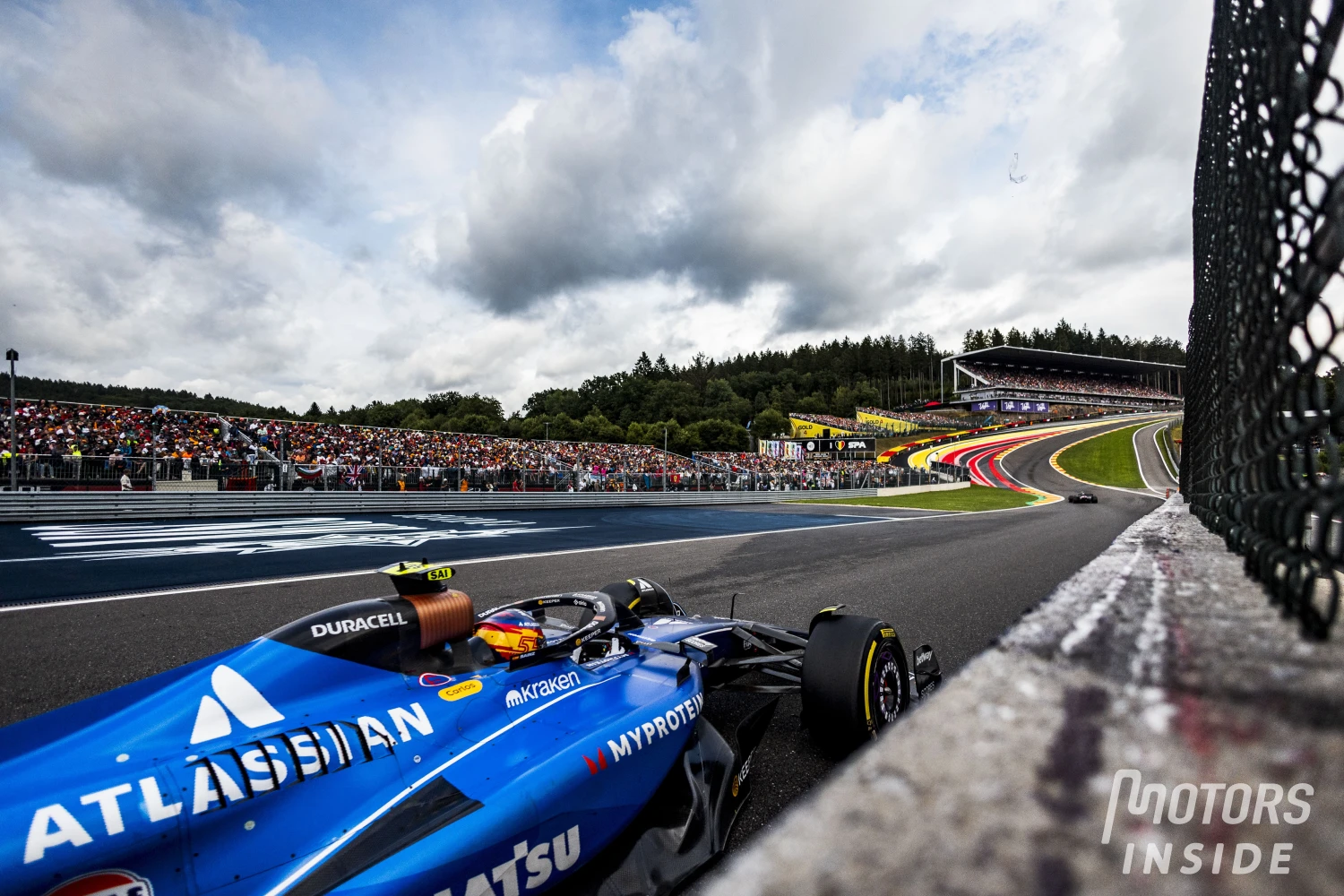
Belgian Grand Prix 2021, at the end of August, rain is expected at Spa-Francorchamps. The circuit is soaked, and under these conditions, the FIA will not allow the drivers to start at the scheduled time. The cars remain protected from the rain under tents, while the stands are getting wet.
After over three hours of waiting, the single-seaters finally take off on the track for a start behind the safety car. The drivers will only complete two laps, in order to consider the race as “completed” and avoid ticket cancellations in particular.
F1s that expel even more water than before
Since 2022, a new regulation aimed at allowing drivers to better follow each other on the track has involved the return of floors and ground effect. Using a diffuser at the back of the car to allow air to violently accelerate and thus stick the car to the ground, this technique also causes a lot more water to be sprayed into the air in wet conditions, much more than before.
Tires are also affected because they throw a lot of water in the air, also disturbing the visibility of the drivers behind. It is this poor visibility that forces the FIA to reduce the running of F1 cars in the event of a wet track.
Change the regulations
In 2022, the FIA, International Automobile Federation, amended the regulations to prevent a lack of spectacle from happening again. Thus, the rule of the leader completing two laps is still in effect, but the regulation now specifies that it only applies if the leader is in race condition without a safety car.
The points system is also reduced with a new system if less than 25% of the race distance is completed. Therefore, only the top 5 would have scored points at Spa in 2021 if this regulation had been implemented.
These changes would have allowed for a better representation of the reality of the race compared to races that reach their conclusion. However, this does not guarantee a refund of tickets if the drivers only complete two laps in challenging track conditions. Another charade of a Grand Prix for the same reasons could therefore occur in the future, once again.
In order to prevent the cars from throwing too much water into the air, a rain kit has been studied by F1, developed by the FIA.
Developing a rain kit to fit on F1 cars
The teams and F1 have asked the FIA to work on a water splash protective kit, which would allow Formula 1 cars to avoid spraying the water lifted by the tires and the underfloor. In this context, an initial development was tested by the FIA during wet track testing at Silverstone.
Several teams present were able to test with a water splash protection kit. Three teams were involved, and while no images have leaked of these kits actually installed on the cars, the FIA has revealed the principle behind the currently developed kit.

In addition to this mudguard located above the tires, another cover is attached behind the tires.
According to these illustrations, no solution has been implemented regarding the water splashes from the diffuser.

The FIA does not approve this anti-projection kit
The initial test results, according to the FIA’s own admission, have shown a lack of efficiency. Nicolas Tombaziz is in charge of the development.
« Obviously, it would have been perfect if we could already confirm that we had a solution to implement in October or around that time, but that is not yet the case », stated Tombazis in an interview with two English media outlets.
« We started this project at the end of last year and did quite a few CFD simulations. We quickly realized that it wasn’t as simple as ‘OK, just put a mudguard on and we’re good to go’. First of all, CFD simulations are quite delicate because we also have to simulate water particles, and when there are water droplets inside the flow field, it’s actually quite complicated physics. »
The worst of the worst
In these conditions where the anti-spray kit is not ready and where the F1 cars are still projecting even more water than before, the FIA could still decide to only run two laps, without a safety car, before raising the red flag and canceling the race.
Thus, the contract of the Grand Prix promoter with the F1 would be respected, allowing the parties to receive their due and the public to witness a new semblance of Grand Prix.
Therefore, the FIA will still need time to allow ground-effect Formula 1 cars to race safely in the rain.